
The terms below are grouped by the job they do: naming the subject, describing relationships between words, describing the processes that move words, describing the evidence, and naming the ways words get coined. Where a guide on this site teaches the idea in full, the entry links to it.
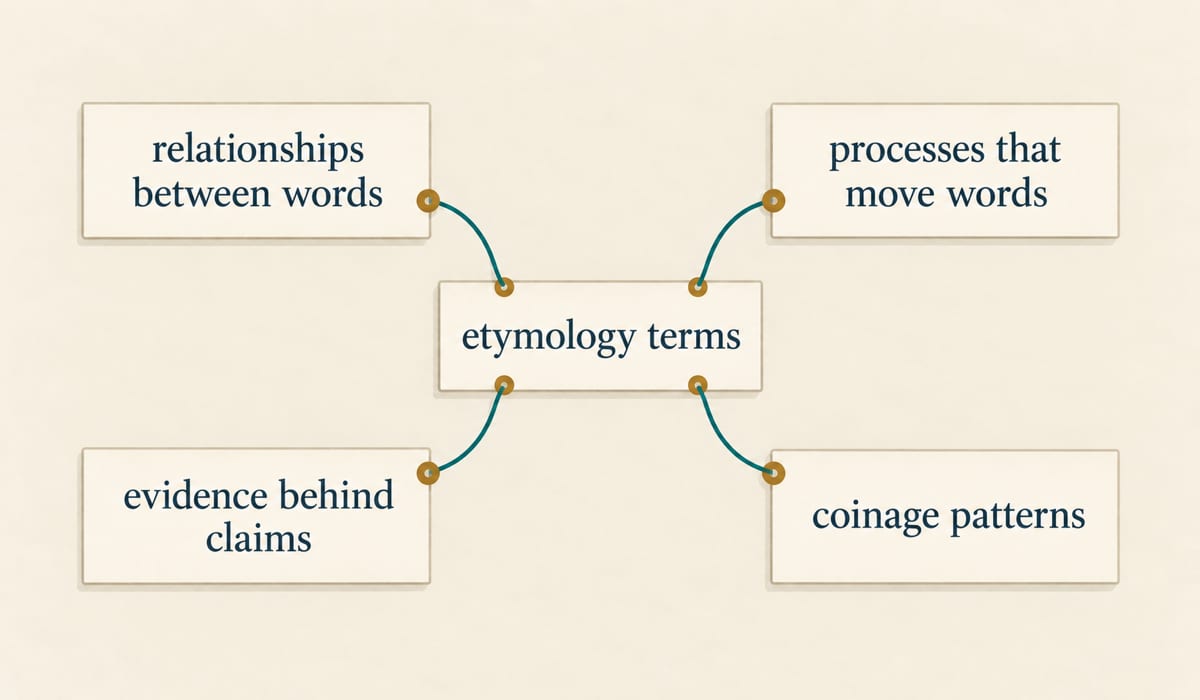
- Relationships between words
- Processes that move words
- Evidence behind claims
- Coinage patterns
Core terms: etymology, etymon, root
etymology
An account of where a word came from — its earlier forms, source languages and meaning changes — and also the name of the field that works out such accounts. As Wiktionary’s editing notes put it, an etymology traces historical development, which is more than dissecting the modern spelling. Try it: run coffee through the lookup and see how its proposed etymology reads.
etymon
The earlier form a word is traced back to — the source at the far end of the chain. When an entry says English tea is “from” an Amoy-dialect form, that form is the etymon. Try it: tea.
root
The deepest element carrying a word’s core meaning. In everyday use it means the base you strip a word down to; in historical linguistics it also names reconstructed ancestral elements such as the Proto-Indo-European roots behind whole word families. Try it: school, whose root lies in Greek skholē.
Relationship terms: cognate, loanword, doublet, false friend
cognate
A word in another language that descends from the same ancestor as yours — family resemblance through inheritance, not borrowing. English father and Latin pater are the textbook pair. Loanwords, cognates and false friends shows how to tell the relationships apart. Try it: window, whose parts have Norse kin.
loanword
A word taken into one language from another, usually adapted in sound or spelling along the way. English is thick with them: coffee from Arabic through Turkish and Italian or Dutch, tea from Chinese by two roads. Try it: coffee.
doublet
One of two words in the same language that share a single ancestor but arrived by different routes — like royal and regal, both from the Latin for “king,” one through French and one more directly. Doublets are how one etymon can leave two footprints. Try it: royal — its doublet regal took the direct road.
false friend
A word in another language that looks familiar but means something different — a translation trap for learners. Similar spelling or sound alone does not establish shared ancestry, and a few false friends are even deceptive cognates whose meanings drifted apart; the trap is the mismatched meaning, whatever the history. Try it: gift — German Gift means poison, the classic look-alike.
Process terms: borrowing, calque, semantic shift, folk etymology
borrowing
The process behind loanwords: a language takes in a word from another and makes it its own. Borrowing is the most visible way words travel, and the one a route diagram can show most cleanly. Try it: tea.
calque
A loan translation — a word or phrase built by translating another language’s expression piece by piece instead of importing its sounds. English skyscraper was calqued into other languages as their own “sky” plus “scraper” compounds. The borrowing is invisible because the parts are native. Try it: superman — itself a loan translation of German Übermensch.
semantic shift
A change in a word’s meaning over time. Essentials of Linguistics names the common directions — widening to cover more cases, narrowing to fewer — and how word meanings change shows how to compare senses without erasing the older ones. Try it: quarantine.
folk etymology
Two things share the name. As a language process, it is the recorded reshaping of an unfamiliar word toward familiar elements — cucaracha becoming cockroach in English mouths. As a warning label, it names a tidy origin story that outruns the evidence. Folk etymology and word-origin myths keeps the two apart. Try it: cockroach, the reshaped word itself.
Evidence terms: attestation, first known use, reconstruction, asterisk
attestation
A recorded occurrence of a form in a dated document — the concrete evidence that a word existed in that shape, in that place, at that time. “Attested” is the opposite of guessed. Try it: robot, whose 1920s coinage is documented.
first known use
The earliest dated evidence a dictionary records for a word, scoped to a particular sense — not the word’s birthday. Merriam-Webster’s date lines carry that scope explicitly, and first recorded use and word invention explains what the line can and cannot settle. Try it: serendipity, a rare documented coinage.
reconstruction
A hypothetical ancestral form inferred by comparing related languages through the comparative method — reasoned, but not found in any surviving document. The method is described in Essentials of Linguistics: reconstructing the past. Try it: school.
asterisk
The mark dictionaries place before a reconstructed or otherwise unattested form — an asterisked word is a hypothesis with method behind it, not a recovered document. When you see * in an etymology, read “inferred, not recorded.” How to read a dictionary etymology entry walks through the full notation. Try it: father, whose ancestry ends in the asterisked Proto-Indo-European root.
Coinage terms: eponym, portmanteau, acronym, back-formation, ghost word
eponym
A word formed from a person’s name. Sandwich carries the Earl of Sandwich’s title; boycott carries Captain Boycott’s. The person’s story and the word’s story then travel separately, which is why eponyms attract embellished anecdotes. Try it: sandwich.
portmanteau
A blend that packs two words into one — smog from smoke and fog, brunch from breakfast and lunch. The term itself comes from Lewis Carroll’s Through the Looking-Glass, where Humpty Dumpty explains the packing. Try it: brunch.
acronym
A word built from initial letters and spoken as a word — scuba, laser. Spoken letter by letter (FBI), the same construction is an initialism. Because acronyms are a real formation pattern, a phrase that happens to fit a word’s letters is a claim to check, not a proof — the myth-checking guide shows why “port out, starboard home” fails it. Try it: scuba.
back-formation
A word created by removing an imagined ending: edit was formed from editor, and pea from pease — an earlier singular and collective word whose final -s was mistaken for a plural ending (Etymonline), and one that Merriam-Webster now lists as a plural anyway. English makes words by subtraction as well as addition. Try it: pea.
ghost word
A word that entered dictionaries through an error and was never genuinely used — a phantom citation, the most famous being dord, which slipped into a Merriam-Webster edition as a supposed synonym for density. A ghost word is proof that even the record has errata. Try it: run dord through the lookup and watch how a reading handles a word with no history to find.
How to use this glossary
Meet the term here, then meet it again in context. The guides index teaches each of these ideas as a working method — relationships, meaning change, dates, entry notation and checking generated output — and each term’s suggested word fills the lookup field without sending anything until you submit. A generated reading is a research starting point; the terms above are how you describe what you find when you check it.
Sources and further reading
- Essentials of Linguistics: semantic change — widening, narrowing and coexisting senses.
- Wiktionary: Etymology — the working vocabulary of etymology sections, including “from”, “ultimately from” and back-formations.
Definitions are original editorial summaries for learners; consult the linked references for the full technical usage. Sources consulted 30 September 2026.