coffee

ˈkȯ-fē

Arabic qahwa reached English coffee through Turkish; dictionaries differ on whether the last step was Italian caffè or Dutch koffie.

Try coffee in the lookup
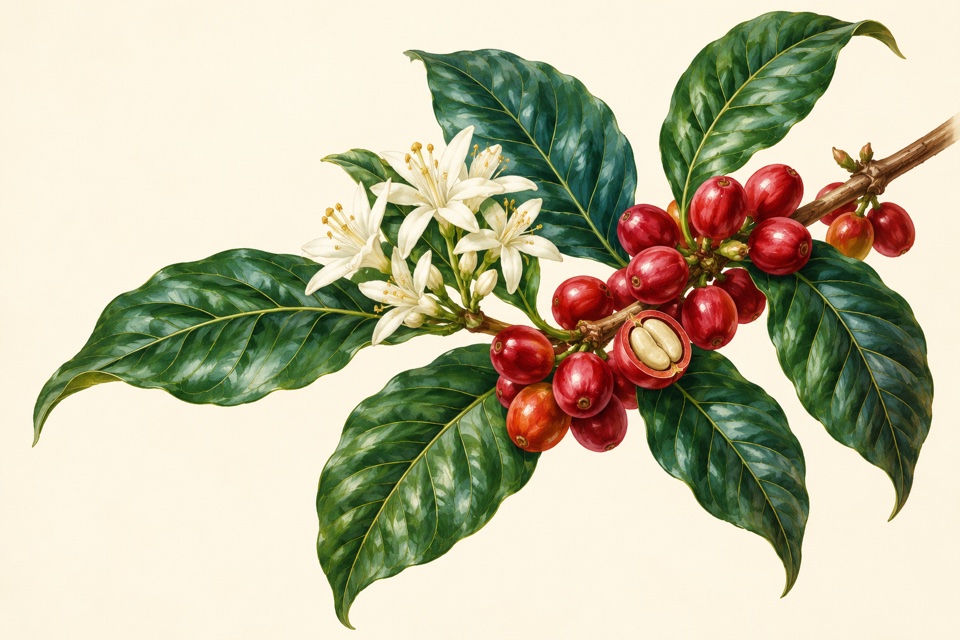
Coffee branch with glossy green leaves, white blossoms, and ripe red cherries.
Decorative illustration

One possible route

The sequence below follows the cited Merriam-Webster entry.

A word routeLanguage forms named in the cited Merriam-Webster entry
  1. Arabicqahwathe source form named in the dictionary
  2. Turkishkahvethe next form in the cited sequence
  3. ItaliancaffèMerriam-Webster's last step; Etymonline gives Dutch koffie
  4. English · nouncoffeefirst known use (Merriam-Webster, sense 1a)1598

A drink carries its name

Merriam-Webster traces coffee to Italian caffè, from Turkish kahve, from Arabic qahwa, and records the English noun in 1598. The Online Etymology Dictionary instead runs the last step through Dutch koffie, and the American Heritage Dictionary describes an Ottoman Turkish qahve reshaped under Italian influence. All three agree the word is ultimately Arabic; they differ on which language handed it to English.

This page summarizes the cited dictionary entries. Follow each source for its full wording, notes and references.

More from the cited entries

Word-specific details from the linked dictionaries, with the dictionary named beside each claim.

Which language handed it over

The route above follows Merriam-Webster's sequence. The Online Etymology Dictionary gives a different last step — Dutch koffie rather than Italian caffè — while the American Heritage Dictionary calls the English word an alteration of Ottoman Turkish qahve influenced by Italian caffè. The early English spellings Etymonline collects, such as chaoua (1598), cahve and kahui, are forms the same dictionary says indicate a derivation from Arabic or Turkish.

None of these is a geographic claim: each is a named language-to-language link in a cited dictionary entry. The disagreement itself is the finding, so the page keeps all three versions instead of picking one silently.
What qahwa might have meant

Behind the borrowing sits a genuine uncertainty. Arab etymologists connected qahwa with a word meaning “wine,” but the Online Etymology Dictionary notes it may instead come from Kaffa, a coffee-growing region of Ethiopia where the plant is called būno — a form Arabic itself borrowed as bunn, “raw coffee.” The deeper origin stays open; the dictionaries record the proposal, not a verdict.

A family built on one word

The same entry family records café (1802, from French café “coffee, coffeehouse”) and cafeteria (1839, American English from Mexican Spanish “coffee store,” with the self-service sense by the 1890s). Coffee-house is from the 1610s; coffee break is attested in 1952, at first often in Pan-American Coffee Bureau advertising.

The word's other recorded senses are later extensions of the drink: “a light meal at which coffee is served” from 1774, and the brown shade from 1815, both in the Online Etymology Dictionary's entry.

Keep following words

Continue with another source-linked example.

All ten examples