
You do not need to prove a word’s entire history in one sitting. A small conclusion with a clear source is more useful than a complete-looking route with missing evidence. This guide gives you a repeatable way to make that conclusion and a simple record you can keep.
Begin with a question you can answer
“Where does this word come from?” can conceal several questions. You might mean when a spelling entered English, how a modern sense developed, whether two words are related, or whether an attractive origin story is true. Write down which question you are asking before searching.
For example, asking about school may concern its earlier Greek source, the development of an educational meaning, or its earliest English record. These are different parts of a history. Our source-linked school example gives a short entry point; a fuller investigation still needs to identify which part you want to check.
Keep the original claim beside your notes. A practical research question might read: “Does the dictionary support the proposed source language for this English noun?” This makes it harder to drift toward an entertaining explanation that answers another question.
Read a dictionary entry in layers
A dictionary page can contain definitions, usage notes, an etymology, a first-use label and examples. Read each part for its own job. A definition explains a sense. An etymology describes a proposed history. A dated example records an occurrence. A date needs the sense or form to which the entry attaches it.
The Oxford University Press archive of OED quotation slips shows one part of the evidence work behind a historical dictionary: collected quotations. That helps explain why a history should be tied to records, rather than treated as a story supplied without evidence.
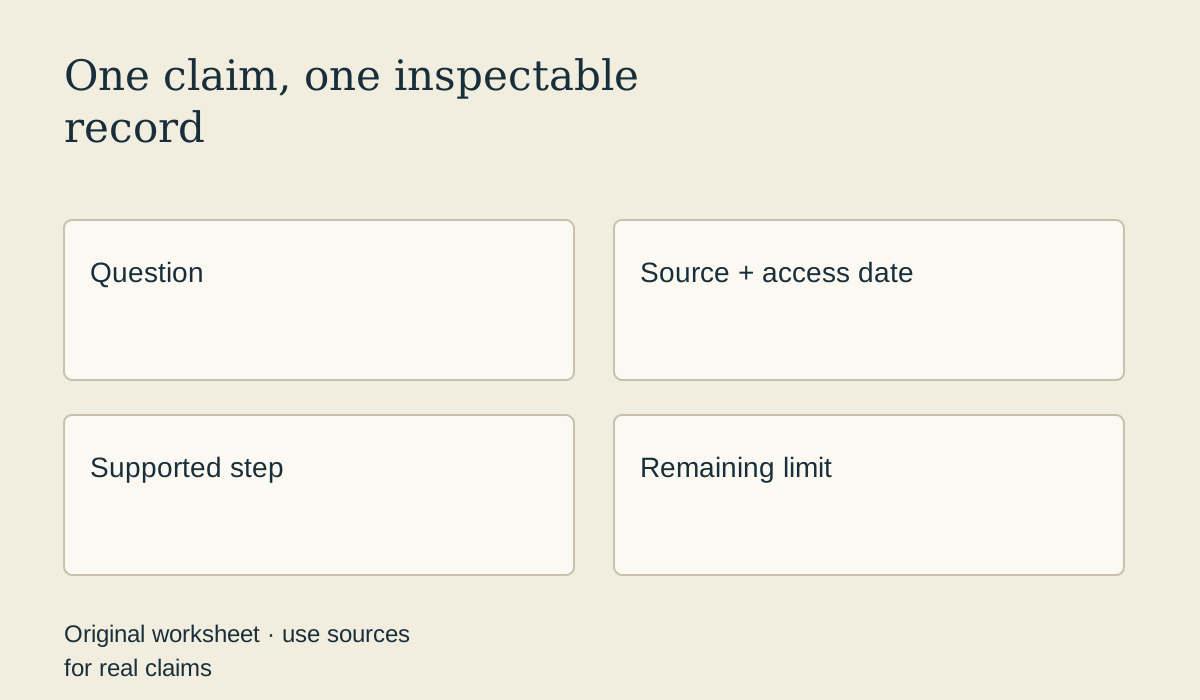
Make your own short note instead of copying a dictionary paragraph. Record the headword, the source’s name, the entry link, the date you consulted it and the specific claim it supports. If you cannot access a full historical entry, record that limitation. A search snippet is a lead; it is not a substitute for the entry.
- Question
- Source + access date
- Supported step
- Remaining limit
Follow forms without inventing a journey
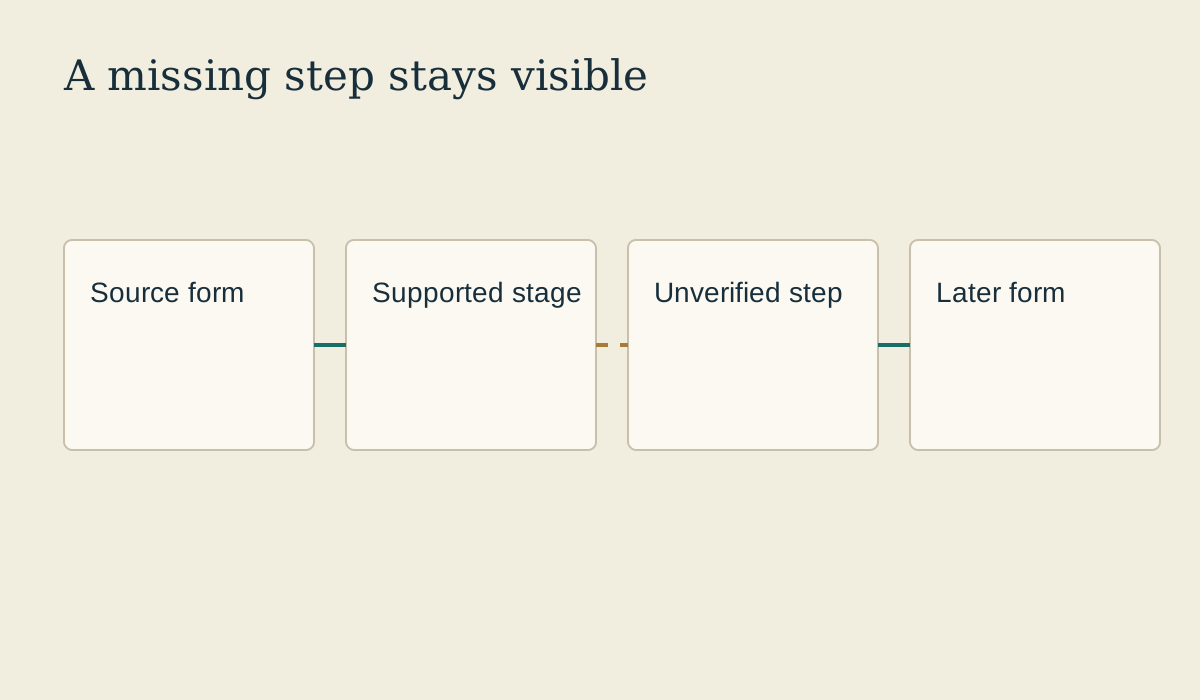
Write down the forms and languages the source actually names. Put them in the stated order, preserve accents and diacritics, and leave unlisted intermediate steps out. Do not add countries, trade routes or travellers simply because the language names suggest a map.
For a concise demonstration, our coffee example follows the forms named in its linked dictionary. Its connectors show a linguistic sequence. They do not establish where a particular traveller carried a drink. A language can be used across several places and communities, and a word route diagram cannot resolve that history by itself.
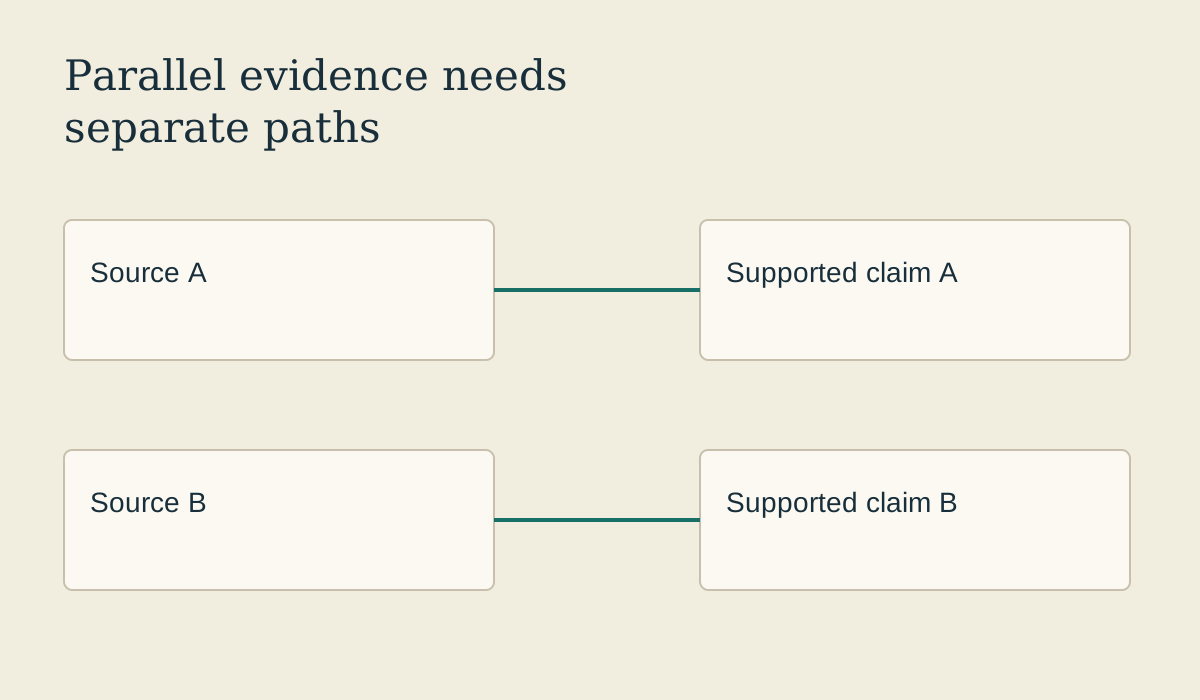
Not every history is a single chain. An entry may name more than one contributing source, a compound made from two parts, or a form created inside a language. Draw parallel paths or a joining point when that is what the evidence requires. If a source says a connection is uncertain, retain the uncertainty in your note and diagram.
Keep meaning beside the spelling
An earlier occurrence is only helpful if you know what the word meant there. Read the surrounding sentence and, when available, the paragraph or page. Ask who used the word, what they were describing and whether the sense matches your question.
Use a note with three separate fields: form, meaning in context and date. This prevents a date for one sense from quietly becoming a birthday for every use of the word. It also allows you to compare a later technical sense with an older everyday use without treating one as an error.
If you are tracing meaning rather than borrowing, read how word meanings change next. It explains how to build a sense comparison that remains useful when older and newer uses overlap.
Check a dated example at its source
If an entry or article gives a quotation, follow its reference when you can. Check the document title, author or publication, date and exact passage. Be alert to the difference between a work’s original publication and a later edition, translation or scan. A catalogue date and a date printed on a newspaper issue may answer different questions.
The Library of Congress Chronicling America collection offers digitized historical newspapers. It is useful for checking printed occurrences within its collection, while its stated scope remains a limit on what a search can show. Do not generalize an empty result to all English, all countries or speech.
Digital search can miss variant spellings, damaged print and material absent from a collection. Treat a promising result as something to inspect on the page. If a search result appears to contain a remarkably early use, confirm the issue and passage before sharing it.
- Source form
- Supported stage
- Unverified step
- Later form
Compare references claim by claim
Open a second suitable reference and compare the same part of the history. Does it name the same source form? Is it discussing the same sense? Does it identify a date differently? Two summaries can appear to agree while actually answering different questions.
Agreement is useful, but repeated evidence is still repeated evidence. If several pages point to one quotation, your record should say that they share that quotation. When references disagree, report what differs and which source you consulted. Do not resolve the disagreement by choosing the most vivid story.
For a relationship question, move to loanwords, cognates and false friends. For an origin tale that relies on a clever expansion of letters or a famous anecdote, use the checks in folk etymology and word-origin myths.
Make a compact evidence record
Use this original worksheet for one claim at a time:
| Field | What to write |
|---|---|
| Question | The word, language, sense and claim you are checking |
| Reference | Entry title, publisher, exact URL and consultation date |
| Supported step | The form, sense or date the reference actually supports |
| Original example | Document, edition, date, passage location and link if available |
| Limit | Missing source, uncertain connection, restricted access or collection gap |
| Conclusion | A short statement no stronger than the evidence |
Suppose you have verified a dictionary’s route but have not inspected its earliest quotation. Your conclusion can say: “This entry gives the following language sequence; I have not independently checked its first-use evidence.” That is a useful result. It tells the next reader where your work ends.
Use generated readings as questions to investigate
Word Says Hi can suggest earlier forms, meaning changes and related words after an explicit submission. Its generated readings are provisional and do not supply verified scholarship. Copy a claim into your evidence record and check it using the steps above. A polished diagram or confident sentence does not make the claim more established.
The curated examples are a separate set of short summaries with entry links. You can read them without submitting a word. If you choose to use the lookup, consult the Privacy page for request and retention details.
- Source A
- Supported claim A
- Source B
- Supported claim B
What counts as a finished investigation?
For an everyday question, finish when you have a clearly scoped claim, a suitable reference and an honest account of any remaining gap. For academic work, follow the citation and evidence standards your course or publication requires. Keep the entry URL and your consultation date so you can revisit the record.
A history can remain incomplete and still be informative. The useful outcome is knowing which steps are supported, which need more work and which should no longer be repeated as fact. To interpret a dictionary date, continue with first recorded use and word invention.
Sources and further reading
- Oxford University Press Archives: OED slips — quotation collection as editorial evidence work.
- Library of Congress: Chronicling America — collection scope and access to historical newspapers.
- Merriam-Webster: coffee and school — entry points for the linked examples, not a complete proof of every historical claim.
The research worksheet and checking sequence are original editorial guidance. Source summaries are intentionally brief. Sources consulted 28 September 2026.