
Word Says Hi word pages cite three dictionaries side by side because no single one owns the whole question. Each reference below does something specific well — and each has a limit worth knowing before you cite it.
What each reference is actually for
Think of the five as five different instruments, not five copies of one instrument:
| Reference | What it is | Access | Best first use |
|---|---|---|---|
| Merriam-Webster | General English dictionary with compact etymologies and sense-scoped first-use dates | Free | A fast dated check on a specific sense |
| American Heritage Dictionary | English dictionary with appendices tracing words to reconstructed Indo-European roots | Free | Following a word to its deep ancestry |
| Online Etymology Dictionary | A dedicated etymology reference written as dated, readable paragraphs | Free | A narrative first pass on a word’s route |
| Oxford English Dictionary | Historical dictionary built on dated quotation evidence | Subscription or library login | The deepest documented record of a word’s life |
| Wiktionary | Multilingual, community-edited dictionary with open etymology sections | Free | Breadth across languages, with a need to check its sources |
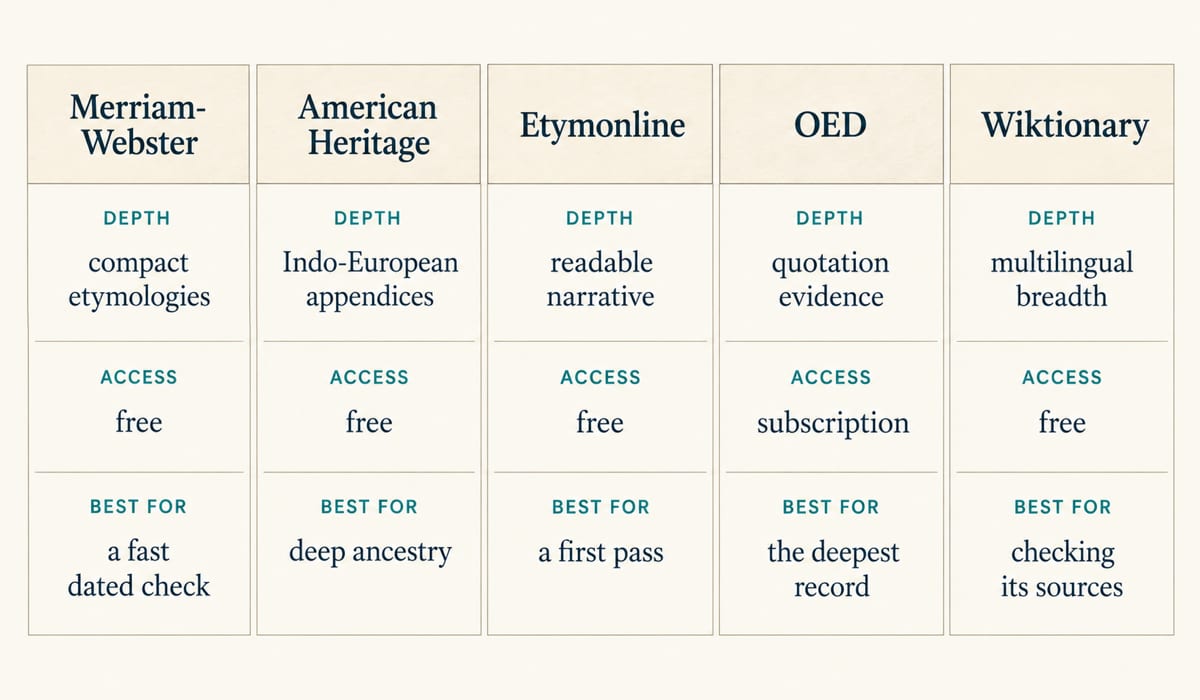
- Merriam-Webster — dated, sense-scoped, free
- American Heritage — Indo-European depth, free
- Etymonline — readable dated narrative, free
- OED — deepest record, subscription
- Wiktionary — broadest coverage, community-edited
Merriam-Webster: dated, sense-scoped etymologies
Merriam-Webster is the quickest dated check. Its entries carry a compact etymology plus a “First Known Use” line that is scoped to a named sense — the dictionary’s own FAQ explains what its etymologies do: if a word was formed inside English, the etymology shows the materials used; if it was borrowed, the entry traces the borrowing back to the earliest records of the ancestral language, and notes related (“akin”) words outside the direct line where relevant.
That scoping is the strength and the limit: a Merriam-Webster date belongs to one sense, not the whole spelling, and its etymology stays deliberately brief. Use it to anchor a claim in a year, then reach elsewhere for the route’s texture. The entry-reading guide decodes its bracketed conventions in detail.
American Heritage: Indo-European appendices
The American Heritage Dictionary carries an unusually handy free feature: its Indo-European Roots appendix groups English words under reconstructed Proto-Indo-European roots, so a single root page shows a family of descendants — a selected set the editors chose to trace, not an exhaustive inventory. Other free references do offer root groupings — Etymonline’s starred-root pages and Wiktionary’s category lists, for instance — but AHD’s appendix is the easiest curated starting point.
That makes AHD the right stop when the question is depth rather than date: not “when did this word arrive?” but “what is it kin to?” The reconstructed roots are hypotheses with method behind them — the comparative method, not recovered documents — so read them as supported inference, which is exactly what the asterisks and “reconstructed” labels signal.
Etymonline: readable narratives with dates
The Online Etymology Dictionary writes what other dictionaries compress. Its entries are short, dated paragraphs in plain prose — when a word is recorded, which language handed it over, and where the record gets thin, often with the hedge words other books bury. It is the friendliest first pass on a route question.
Its limits are the format’s limits: a compiled secondary reference rather than a quotation-evidence archive, so treat its dates as well-sourced leads and confirm load-bearing claims in a primary-record dictionary when it matters.
OED: the deepest record, and its paywall
The Oxford English Dictionary is the heavyweight: a historical dictionary whose entries rest on dated quotations showing a word actually in use. The scale of that evidence work is documented — the Oxford University Press Archives note that over five million dictionary slips were collected for the first edition alone, carrying quotations, definitions and etymologies written out between 1857 and 1928.
The honest caveat is access: the OED online is a subscription reference, reached through an institutional or library login or a paid personal subscription — not a free lookup. When a question is worth that depth, check whether your public or university library provides access; many do. The dictionary’s own guide to using the OED explains what each part of an entry contributes — worth reading before you pay for a route question that a free reference could have settled.
Wiktionary: broad, multilingual, community-edited
Wiktionary covers what the curated dictionaries miss: enormous breadth, many languages, transparent etymology sections with published conventions — its etymology guidelines spell out what “from”, “ultimately from”, a back-formation notation and an asterisked reconstructed form each claim.
Because anyone can edit it, the quality moves with the sourcing inside each entry. A Wiktionary etymology that cites dated texts or standard references is a useful lead; an uncited one is a hypothesis to check elsewhere. Use it for breadth and cross-language tracing, and let its citations do the work.
A two-source habit that fits a lunch break
You do not need all five every time. The efficient habit runs like this: start with the question the word raises — date, route, depth or breadth — then open the reference built for it, plus one other that works differently. Agreement between two unlike sources is decent support; a split is information, and the disagreement guide shows how to report it without forcing a winner.
The pattern repeats on this site’s own pages. Our robot example carries Merriam-Webster’s 1922 beside the 1923 that Etymonline and American Heritage record — two clocks on one coinage, both kept because each is scoped to its own evidence. When your question is which is “right,” the answer is usually “right about what it counted.”
One limit sits outside all five: a dictionary entry is a distillation, not the record itself. When a claim is load-bearing — a publication, a disputed route, a family-history question — the object of last resort is the dated quotation or the citation the entry rests on, and the research guide shows how to keep that evidence trail honest. And the five references above are English-facing: a borrowed word’s deeper route may live in a specialist work for the language it came from.
And the ordering matters: a generated Word Says Hi reading is where the question comes from, not where it ends. Look the word up, see the proposed route, then check the load-bearing steps in the references above — the example pages show what a fully cited result looks like.
Sources and further reading
- Merriam-Webster: where do new words come from — how the dictionary builds and scopes its etymologies.
- American Heritage Dictionary: Indo-European Roots appendix — the appendix that groups English words by reconstructed root.
- Online Etymology Dictionary: *gene- — a free root page grouping English derivatives, an alternative route into deep ancestry.
- Oxford University Press Archives: OED slips — the slip evidence behind the historical dictionary.
- Wiktionary: Etymology — the community dictionary’s documented conventions.
- Oxford English Dictionary: how to use the OED — the reference’s own guide to what its entries contain.
The comparison framing and the checking habit are original editorial guidance. Source summaries are intentionally brief. Sources consulted 1 October 2026.