
You open a dictionary entry and meet a line like “Italian caffè, from Turkish kahve, from Arabic qahwa.” It looks like shorthand for insiders. It is shorthand, but a short set of conventions unlocks all of it. This guide decodes each piece, then reads a real entry end to end.
Where the etymology sits in an entry
A dictionary entry is several different records stacked together: the headword and pronunciation, definitions grouped by part of speech, sometimes usage notes and examples, an etymology, and a first-use date. In Merriam-Webster’s print entries the etymology sits in square brackets just after the headword line; on its website the same material appears under “Word History,” where “Etymology” — without the brackets — and the “First Known Use” line follow the definitions. Other dictionaries place the same material differently — the Online Etymology Dictionary writes a short dated paragraph — but the pieces are the same pieces.
Before reading the etymology, note which sense the entry is covering. A noun and a verb with the same spelling can carry different histories, and a date attached to one sense does not settle the other. First recorded use and word invention explains why that scoping matters.
The language chain: from, through, back to
The heart of the bracketed line is a chain of language names joined by from. Read each “from” as one claimed step: the word moved from the language after the “from” into the language before it. “From Turkish kahve, from Arabic qahwa” claims two steps — Arabic into Turkish, Turkish onward — ending wherever the chain started reading.
Two cautions keep the chain honest. First, a chain names languages, not routes on a map: “from Arabic” tells you which language supplied the form, not which ship carried it. Second, different references compress differently. Wiktionary’s etymology conventions spell this out: a bare “from” means a single step, while “ultimately from” warns that intermediate languages have been left out. When a source abbreviates, the skipped steps are an open question, not an error.
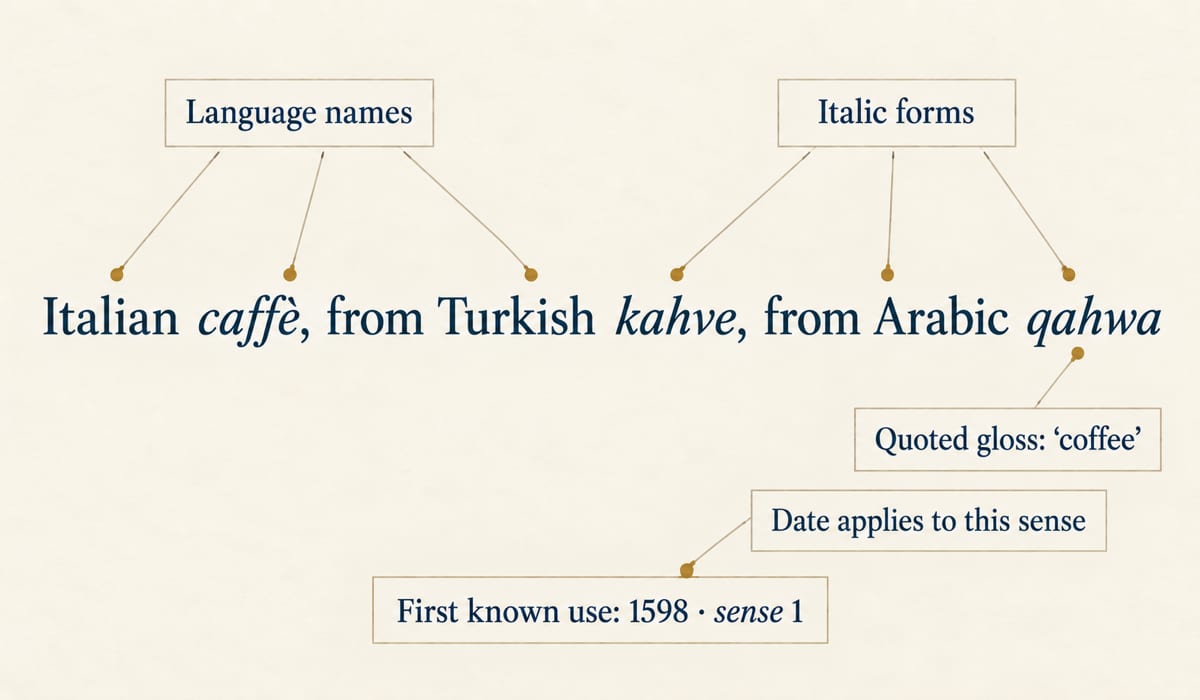
- Language names
- Italic earlier forms
- Glosses in quotes
- Date line below
Italic forms, transliteration and the asterisk
The italic spellings between language names are the earlier forms themselves — what the word looked like in that language, in that source’s spelling conventions. Keep them exactly: accents and long-vowel marks carry information, so caffè and kahve are different claims, not decoration. Where the source language uses another script, the entry gives a transliteration; treat it as the dictionary’s rendering of the foreign form, not the original spelling.
Quoted strings after a form are glosses — the earlier form’s meaning, briefly. So “Arabic qahwa ‘coffee’” supplies both shape and sense for that step.
A leading asterisk is the one symbol worth memorising: it marks a reconstructed form that no surviving document records, inferred by comparing later languages. The Merriam-Webster etymology notes use it for unattested ancestral forms, and the conventions behind it come from the comparative method described in Essentials of Linguistics. An asterisked form is a supported hypothesis to read carefully — not a discovered document.
Part-of-speech labels and sense numbers
Entries hang their etymology and dates on labels. A headword marked noun may share the page with a verb homonym that has its own entry and its own history. Inside one entry, numbered senses — 1a, 1b, 2 — divide the word’s meanings. An etymology placed at sense level belongs to that sense, not the whole spelling.
This is the single most common misreading: carrying a fact from one part of the entry to another. If the entry dates the noun’s first sense but your question concerns the colour sense listed at sense 2, the date has not answered you yet. The date belongs where the entry put it.
What ‘first known use’ lines add
The separate date line — Merriam-Webster labels it “First Known Use” — reports the earliest dated evidence the dictionary records for the headword, with a sense qualifier such as “in the meaning defined at sense 1a.” The Merriam-Webster first-use notes are explicit about the limit: the date is the earliest use the editors have found, not the moment the word was invented. Earlier evidence can always surface.
So the date line and the etymology answer different questions. The etymology proposes where the form came from; the date marks when the record currently starts. A word can have a confident chain and a date that still moves, and both statements stay true.
Worked example: reading coffee’s entry
Merriam-Webster’s coffee entry opens the etymology “Italian & Turkish” — naming both languages as possible immediate sources rather than choosing one — then prints the chain “Italian caffè, from Turkish kahve, from Arabic qahwa” and dates first known use to 1598 for the noun’s first sense. Decoded with this guide’s conventions: the ampersand keeps the last step open — English may have taken the word straight from Turkish kahve or through Italian caffè — while the printed chain claims three steps, each a language-to-language link, and the earliest English record the editors cite lands in 1598 for the drink sense.
Now the payoff of reading carefully. The Online Etymology Dictionary’s coffee entry gives the last step to Dutch koffie — one immediate source where Merriam-Webster keeps two — and dates English “c. 1600”, a rounder date on a different final link. Neither is sloppy; they have drawn the boundary of the claim differently. When dictionaries disagree takes up why that happens. Our coffee example page keeps all three cited accounts side by side for exactly this reason.
Try it on a word you choose
Pick a word and open its entry in a dictionary that prints an etymology. Copy the etymology line onto a note, then mark it up with this original decoding sheet:
| Notation | What it records |
|---|---|
| Language name + “from” | One claimed step into that language |
| Italic form | The word’s earlier shape in that source |
| Gloss in quotation marks | The earlier form’s meaning, briefly |
| Asterisk before a form | A reconstructed form with no surviving record |
| “Ultimately from” | Intermediate steps left out of the chain |
| Sense label beside a date | Which meaning the first-use record covers |
What remains unexplained after the markup is your real question — a skipped step, an asterisked reconstruction, or a sense the entry does not date.
For a second angle on the same word, run it through the Word Says Hi lookup. The generated reading proposes its own sequence of forms and languages; compare it link by link with the dictionary notation you just decoded, and keep the places where they diverge as questions. The curated examples show what a source-linked account looks like when the dictionary entries are already attached. Generated readings are research starting points, not verified scholarship — the entry you decoded is the check.
Sources and further reading
- Merriam-Webster explanatory notes: etymology — the conventions behind the bracketed line, including reconstructed forms.
- Merriam-Webster explanatory notes: first known use — what the date line covers and what it leaves open.
- Wiktionary: Etymology — how a second major dictionary format writes “from”, “ultimately from” and related notation.
- Essentials of Linguistics: reconstructing the past — the comparative method behind asterisked, unattested forms.
The decoding sequence and worksheet are original editorial guidance. Source summaries are intentionally brief. Sources consulted 30 September 2026.