
Every etymology is a road that eventually runs out of pavement. Latin ends somewhere; before it there is no Latin record, only earlier relatives. This guide is about the territory past that signpost — reconstructed Proto-Indo-European, the asterisk convention that marks it, and how much weight a starred form can bear.
A language nobody wrote down
Proto-Indo-European is the name linguists give the ancestor shared by the Indo-European family — a family whose documented members include English, Latin, Greek, Sanskrit and dozens more. The catch is total: no inscription, tablet or scrap of it survives. Writing itself only reaches back to roughly the fourth millennium BC in Sumer, and most languages that were ever spoken were never written at all — a point the Essentials of Linguistics chapter on reconstruction makes before doing anything else.
So the language is known only backwards. Where descendant languages preserve independent records, scholars compare them and work out what the lost ancestor probably sounded like. The American Heritage Dictionary’s Indo-European appendix exists precisely because of this: it collects the reconstructed roots English words can be traced to, because no PIE dictionary could ever be compiled from texts.
What the asterisk marks
The asterisk is the field’s honesty device. In a dictionary etymology, a form prefixed with * is unattested — posited by reconstruction, not copied from a document. Merriam-Webster’s explanatory notes use the same convention, and the signal is categorical: the star means “no surviving record of this exact form,” full stop. It does not mean “wild guess” — a starred form can rest on dozens of descendant witnesses. And it does not mean the meaning is uncertain; it marks the form’s documentary status.
Stars also stack. An etymology can carry you past several unattested waypoints: brother is documented back to Old English brōthor, but the Proto-Germanic *brōthar- behind it is already reconstructed, and the PIE *bhrāter- behind that is reconstructed again. Each asterisk is a step off the record — keep count as you read.
How reconstruction works, briefly
The method has a name: the comparative method. The Essentials of Linguistics chapter glosses its core move — compare cognates, words in related languages that descend from the same ancestor, and extrapolate backwards to “a single plausible hypothetical ancestral form,” the etymon. Latin pater, Greek patēr and Sanskrit pitṛ line up too systematically to be coincidence, so scholars infer the ancestral form that most economically predicts all three.
The same chapter is equally clear about the method’s limits. Similarity alone is not evidence — house and Haus look and mean alike in two related languages, but near-identical look-alikes also arise between unrelated languages by chance or by borrowing; English giraffe and German Giraffe are both loans, and counting them as inherited cognates would corrupt the comparison. Reconstruction is disciplined pattern-matching against noise — which is why its outputs are hypotheses with confidence levels, not recovered facts.
One root, many descendants
The AHD appendix’s entry for *bhrāter- — glossed “brother, male agnate” — reads like a family reunion. English brother and, by a stranger path, bully both come “from Germanic *brōthar-.” A second group arrives “from Latin frāter”: fraternal, friar, fraternity, fraternize. Greek phrātēr — “fellow member of a clan” — delivers phratry. And the list ends at pal, traced “from Sanskrit bhrātā,” with several intermediate languages compressed into that single line.
One reconstructed root, five-plus English words, four different documented channels. The appendix’s parenthetical note does quieter work than the drama: “both a and b from Germanic *brōthar-” shows a second asterisk sitting between the PIE root and the recorded languages — a proto-language’s proto-language. To see the same word from the borrowing side instead of the kinship side, the loanwords, cognates and false friends guide keeps the two relationships separate, and the doublets guide shows what happens when two of those channels feed one language.
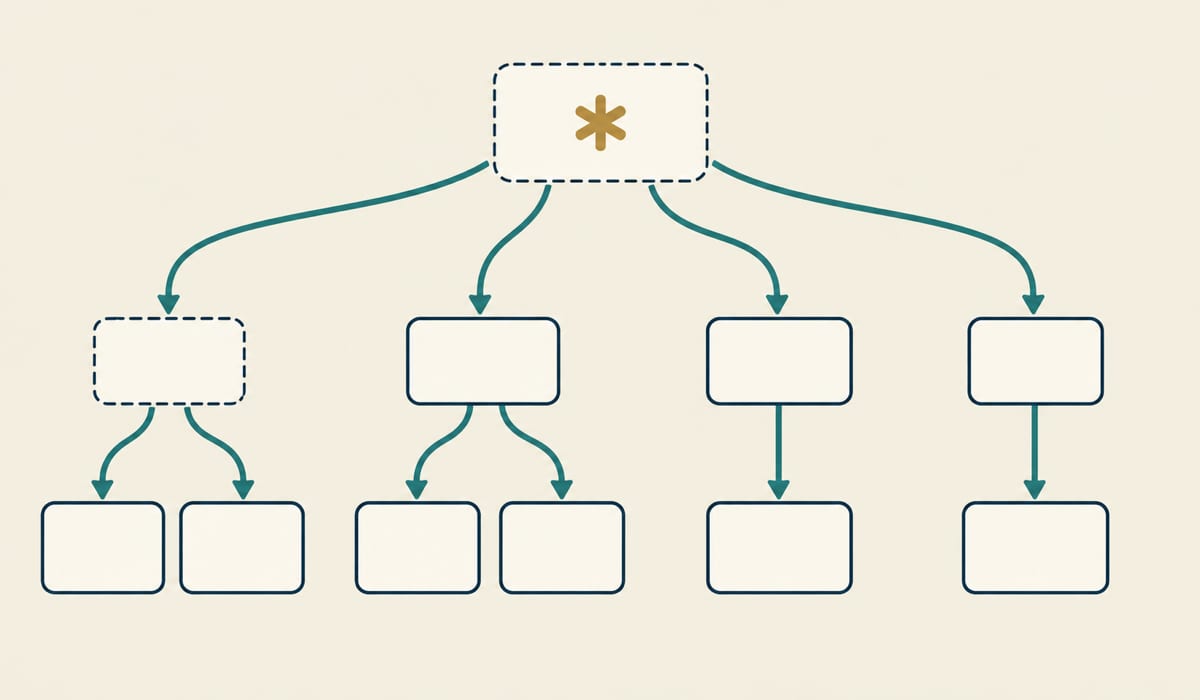
- *bhrāter- — unattested
- Germanic *brōthar- → brother, bully
- Latin frāter → fraternal, friar
- Greek phrātēr → phratry; Sanskrit bhrātā → pal
Why PIE claims carry the most uncertainty
Every etymological claim is a hypothesis; a PIE claim is a hypothesis at maximum distance. The witnesses are all indirect — no scribe ever wrote the root down — and the chain leading back to it mixes the two kinds of evidence this guide has kept separate: some intermediate forms are attested (Old English brōthor, Latin frāter), while others are themselves reconstructed (Germanic *brōthar-). A generated reading that ends in a starred form is proposing the deepest, least directly evidenced step in the whole account; the honest reading of a route like that is “plausible scholarly inference,” not “recovered fact.”
That is worth saying plainly because the asterisk is easy to misread in both directions — as decoration, or as a mark of failure. It is neither. It is a precision instrument: the difference between frāter (attested in Latin texts) and *bhrāter- (inferred from its descendants) is written into the notation. When you report a PIE claim, report it as reconstruction; and when you see one printed without a star, check the reference’s own notation before judging it — some sources, the AHD appendix included, mark reconstruction in other ways. The checking method in check a generated history treats this as a special case of its general rule: the farther a claim sits from a documentable source, the more it needs named support. The curated school page shows what this looks like inside one entry: a solidly documented chain from Greek scholē through Latin to English, ending in the starred Indo-European root *segh- — the line between recorded and reconstructed drawn exactly where the star falls.
Reading an Indo-European appendix entry
The AHD appendix has a compact grammar worth learning once — and its own asterisk convention. Each entry opens with the root in bold and a short gloss — “bhrāter- Brother, male agnate” — printed without a star, because the appendix itself is already a catalogue of reconstructions; inside an entry the asterisk still does its usual work, marking unattested intermediate forms like Germanic *brōthar-. Descendants then follow in numbered groups, each ending in the formula “from language form.” Combined notes handle shared branches (“both a and b from Germanic *brōthar-”), and alternate forms appear parenthetically, sometimes with centum/satem or ablaut remarks. A bracketed reference such as “[Pokorny …]” points to the older scholarly collection the entry is built on — Julius Pokorny’s Indogermanisches etymologisches Wörterbuch, the standard mid-century inventory.
So a single line — “1. brother, from Old English brōthor” — is doing three things: naming an English descendant, identifying the attested ancestor it descends from — the appendix gives ancestry, not dates, so a first-use date still needs a dated dictionary entry — and silently asserting the unbroken chain back to the reconstructed root above. Read the appendix as a map of claims, strongest at the leaves, most hypothetical at the trunk. For a guided walk through the family itself, the University of Texas Linguistics Research Center keeps free lessons on early Indo-European languages; to see the starred notation inside an ordinary dictionary entry, the entry-reading guide annotates one line by line.
Sources and further reading
- American Heritage Dictionary: Indo-European roots appendix — the reconstruction inventory, including the *bhrāter- entry used above.
- Essentials of Linguistics: reconstructing the past — the comparative method, cognates, etymons and the limits of resemblance.
- UT Austin Linguistics Research Center: Indo-European studies — free lessons on early Indo-European languages for going deeper.
- Merriam-Webster: dictionary etymology notes — the asterisk convention in ordinary dictionary entries.
The reading method and the route-uncertainty framing are original editorial guidance built on the linked sources. Source summaries are intentionally brief. Sources consulted 1 October 2026.