
Begin by deciding what you want to know: how the word arrived, whether two forms share ancestry, or whether one is a reliable translation of the other. A single visual resemblance cannot answer all three. This guide explains how to keep the questions separate and build a small, useful comparison.
A loanword asks about a transfer
A loanword is a word taken into one language from another. To investigate borrowing, look for the source language and the form the recipient language received. Then check whether the reference gives earlier stages. The immediate source and a more distant source are different parts of the same inquiry.
Merriam-Webster’s explanation of etymology distinguishes a borrowing line from related words that sit outside that line. This distinction matters when a dictionary lists several familiar-looking forms: being mentioned in the entry does not automatically make a form an intermediate borrowing step.
Use the coffee example as a small exercise. Read its linked dictionary and copy only the named sequence. Keep the language labels attached to the forms. Then ask which form the entry gives as the source nearest to English. You are checking an entry’s account, rather than drawing a route from assumptions about modern geography.
A cognate asks about shared ancestry
In historical linguistics, cognates are words related through a shared ancestral form. A cognate comparison therefore needs evidence for the relationship, not just a visual match. Sound correspondences and the history of the languages matter; a pair of modern spellings is only a starting observation.
For an accessible academic explanation, consult the reconstruction chapter in the second edition of Essentials of Linguistics. Its historical framework helps separate inherited relationships from borrowing. When a dictionary says a word is “akin” to another form, check what kind of relation the entry is describing before placing that form on a direct path.
The useful picture here is a branch: one ancestral form with later descendants. The useful picture for borrowing is a transfer between language labels. These drawings answer different questions. Neither diagram becomes evidence until its forms and connectors are tied to a suitable source.
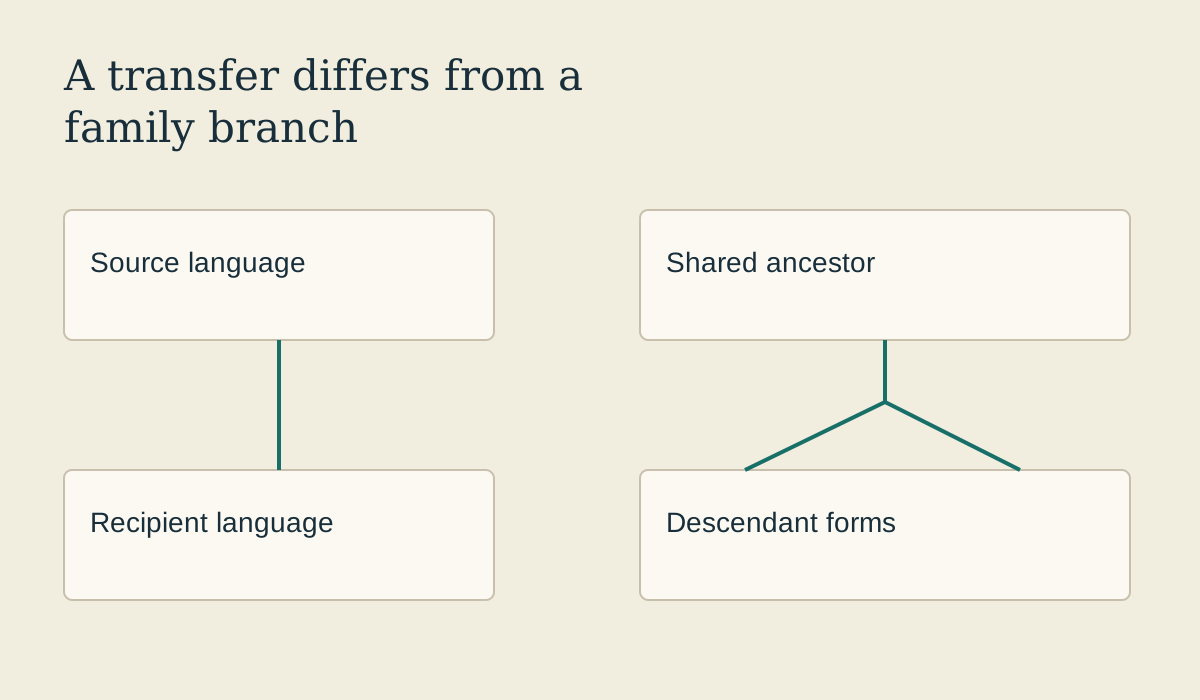
- Source language
- Recipient language
- Shared ancestor
- Descendant forms
A false friend asks about meaning
For a language learner, a false friend is a similar-looking or similar-sounding word that encourages an unreliable assumption about meaning. The practical question is whether the form works as expected in the target language. Check a current entry and a sentence in context before using it.
The Cambridge Dictionary entry for false friend gives the learner-oriented definition. In historical discussions, terminology can be narrower: a writer may focus on related words whose meanings have diverged. State which use of the term you mean. Misleading resemblance and shared ancestry are different properties, so you should not infer one from the other.
For a learner, start with a sentence you genuinely need to say. Find the target word’s relevant sense, register and grammatical pattern. Then check whether the similar word in your own language expresses that same sense. A match in one context does not guarantee a match in every context.
Keep history and translation in separate columns
An effective comparison sheet has room for both. Use these original questions:
| History question | Usage question |
|---|---|
| What source form does the reference name? | What does the word mean in this sentence? |
| Is the relationship borrowing or inheritance? | Is the register formal, informal or specialized? |
| Which stages are supported? | Which grammar or collocations does the entry show? |
| Does the reference mark uncertainty? | Is the intended sense available in the target language? |
This stops a familiar origin from doing the job of a translation check. A word’s history can explain why two forms resemble one another, while a current dictionary explains whether your intended use is natural. Keep both links when both questions matter.
Beware the hidden extra step
Suppose a reference gives word A as a source of word B and separately says that word C is related. Do not redraw the information as A → C → B. That inserts a stage the reference did not supply. A neat line can make the mistake harder to notice because it looks complete.
The same problem appears when a summary jumps from a distant root to a modern word. You may have a supported ancestral relationship but no account of the intermediate borrowing stages. Label the summary at the level the source supports. “Related through a shared root” and “borrowed directly from” are different claims.
Our research guide explains how to record the source and limit for each connector. If there are several partial sources, use separate paths. The quarantine example demonstrates why an entry can need more than one source line.
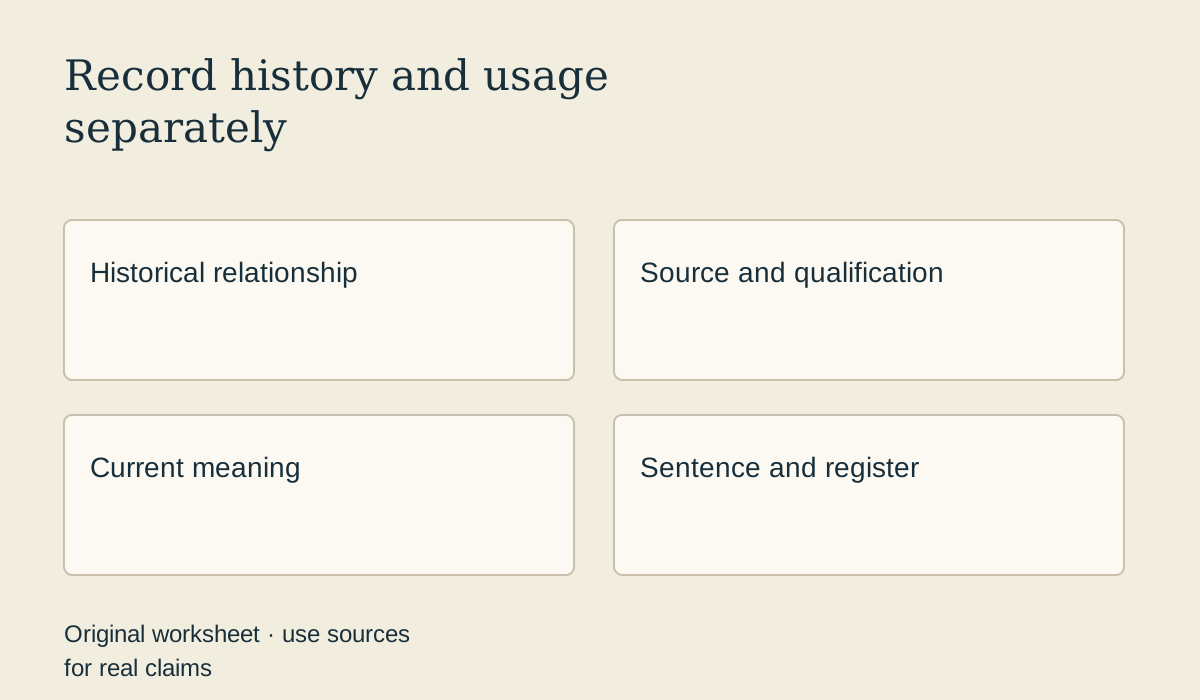
- Historical relationship
- Source and qualification
- Current meaning
- Sentence and register
Run a four-step relationship check
First, record the two forms exactly, including the language, accents and intended sense. Do not silently normalize away information that helps identify the entry. If you only have an image or an uncertain spelling, settle the form before making a historical claim.
Second, find a reference that addresses your question. A learner’s dictionary is useful for current meaning. A historical dictionary or linguistic text is useful for ancestry and borrowing. One resource may cover both, but read its sections for their separate purposes.
Third, write one relationship sentence. It might say that a source reports borrowing, that a text identifies a common ancestor, or that two current entries show a translation trap. Avoid packing every possible relationship into a single label.
Fourth, record the limits. Perhaps you verified the current meanings but not the ancestry. Perhaps the historical source proposes a relationship with a qualification. A note such as “usage checked; origin unconfirmed” gives another reader a much clearer result than an unqualified badge.
Make a learner note that you can reuse
For a word you keep confusing, write the target-language sentence, a short explanation of the intended meaning and a link to the current entry. Add a contrasting sentence for the similar form if that helps. Keep the examples natural and specific rather than attempting to summarize every dictionary sense.
For a history you want to explore, keep the source forms in a separate note and mark the kind of connector. This creates two useful learning tools: one helps you use a word; the other helps you understand its background. They can inform one another without being merged.
If two related forms have developed different senses, continue with how word meanings change. If the proposed connection rests only on a clever resemblance, read folk etymology and word-origin myths before repeating it.
Where Word Says Hi fits
A generated reading can suggest forms worth checking, but it cannot establish that a pair is cognate or a borrowing. Treat each suggested relationship as a question. The source-linked examples provide short starting points with dictionary links. Keep your conclusion attached to the resource that actually supports it.
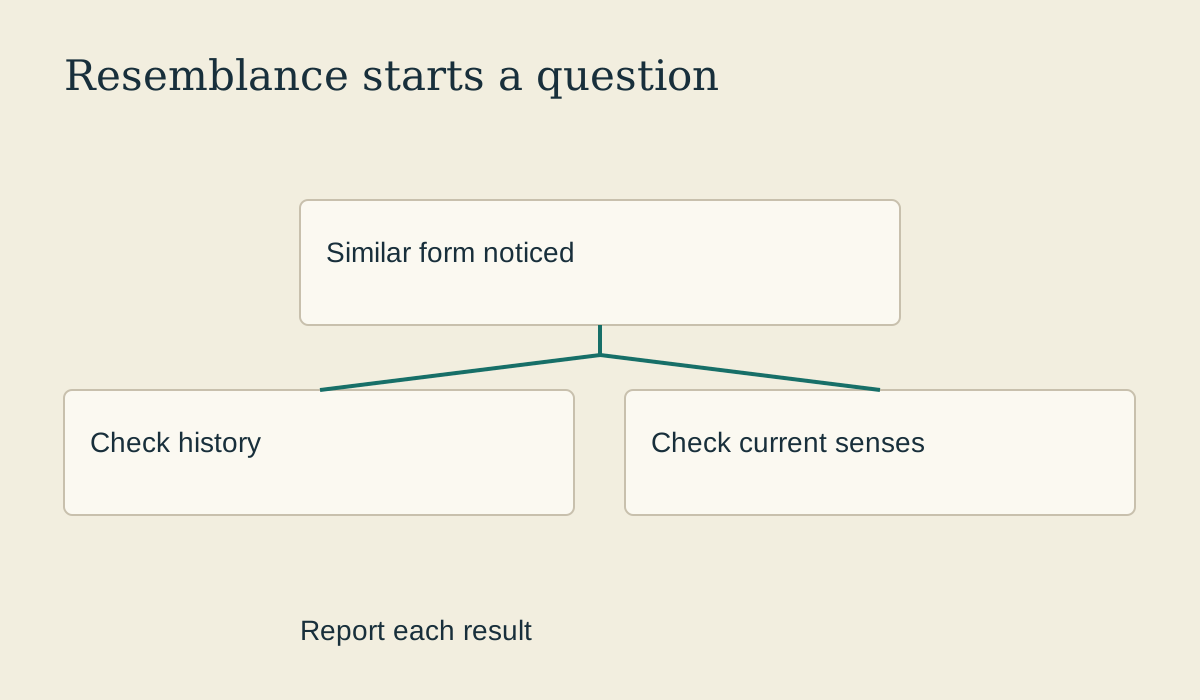
- Similar form noticed
- Check history
- Check current senses
- Report each result
Sources and further reading
- Merriam-Webster: etymology conventions — borrowing lines and related forms outside those lines.
- Essentials of Linguistics, second edition — historical linguistic teaching, including lexical relationships.
- Cambridge Dictionary: false friend — learner-oriented definition.
- Merriam-Webster: coffee and quarantine — concise worked examples linked from this guide.
The comparison sheet and checking sequence are original editorial guidance. Sources consulted 28 September 2026.