
A word that grew from a place name is called a toponym — the geographic cousin of the eponym, which fossilizes a person instead. Both work the same way: a proper name gets used so often for what came from there that the name becomes the thing’s ordinary word. The difference is what’s embedded — a city, a port, an island — and how worn down it got on the way in.
The place hiding in the word
The pattern is almost always practical. A cloth, a fruit, a bird or a style arrives from somewhere, and the name of the somewhere comes along for the ride — usually as an adjective first (“from Nîmes,” “of the Canary Islands”) before fusing into the word itself. What’s left behind is a place name hiding in plain sight, often disguised by centuries of wear.
That disguise is what makes checking worthwhile. A word like denim doesn’t announce its city; the connection is invisible until you uncompress the spelling. The three cases below are all documented — and they show the three shapes the link can take.
Denim: serge de Nîmes
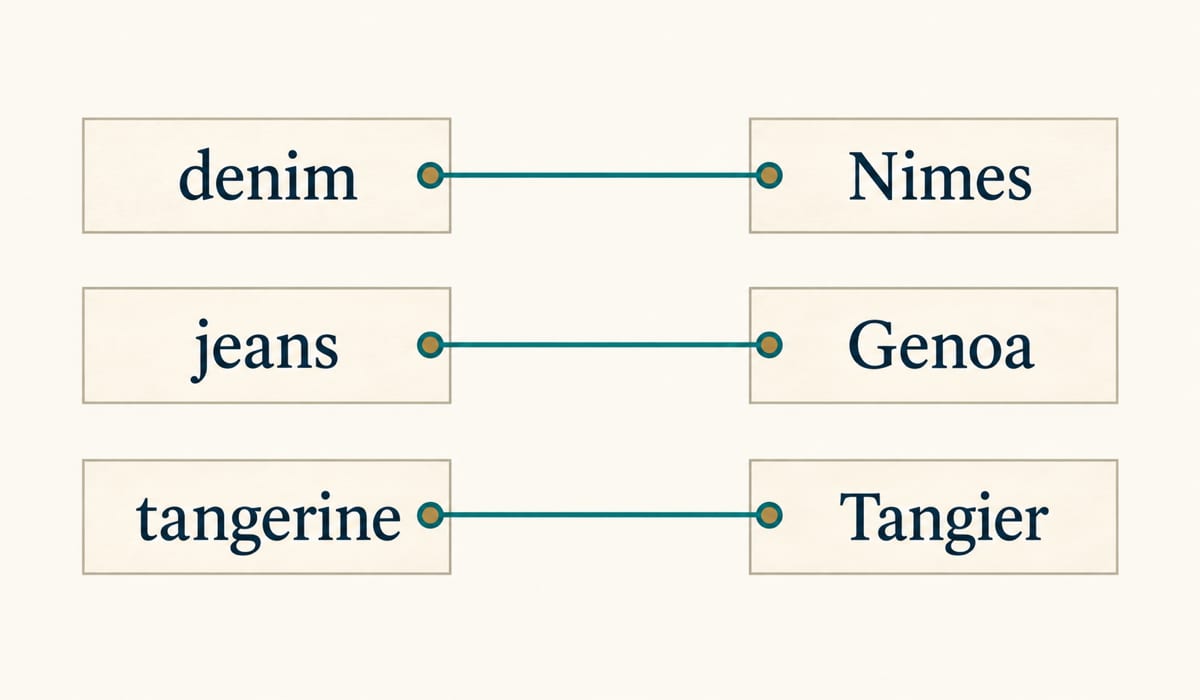
The Online Etymology Dictionary records denim from the 1690s, from French serge de Nîmes — “serge from Nîmes,” the southern French city known for its twilled wool and later cotton cloth. Say de Nîmes fast a few times and you can hear the compression at work: the preposition and the city squeezed into six letters that no longer look like either.
Note what the claim does and doesn’t say: the fabric was named for the city, which is different from claiming the fabric was invented there. Toponyms mark association — where the goods were known from — not necessarily the point of origin. The port that ships a thing is not the land that grows it: Tangier exported the oranges the tangerine was named for, which is not the same as saying the fruit was grown there.
Jeans: from Genoa
Jean is older and subtler. The same dictionary traces it to the mid-15th century, when the cloth appears in English as Geayne — short for Gene fustian, from French jean fustian, “fustian of Genoa.” Genoa, the Italian port, sits inside jean through the French name for the city. The plural jeans became standard by the mid-19th century, and the trousers sense is recorded by 1908 — the Etymonline entry adds, almost wistfully, “not originally blue.”
So the two trousers in your drawer carry two different cities: Nîmes by compression, Genoa by a French rendering of the city’s name. The garments may have layered on each other’s meanings, but the words kept their separate addresses.
- denim — Nîmes
- jeans — Genoa
- tangerine — Tangier
Tangerine and currant: ports and produce
Ports export names as efficiently as goods. Tangerine is recorded in 1842 — short for tangerine orange (1820), literally “an orange from Tangier,” the Moroccan seaport from which the fruit was imported to Britain, per the Etymonline entry. The place adjective simply became the fruit’s name.
Currant is the odder story, and the more instructive one: it’s a shortening of raysyn of Curans, “raisins of Corinth,” from late-14th-century English — the small dried grapes were exported from southern Greece. Per Etymonline, the final -s was then mistaken for a plural and stripped — the same false-singular subtraction that produced pea from pease, stacked inside a place name. And the name travels further still: in the 1570s English speakers applied currant to an unrelated northern European berry on resemblance alone.
When the place link is real but indirect
Not every toponym embeds the place name phonetically. A canary is a bird named “of the Canary Islands,” where it is native — the word arrived in 1650s English, short for Canary-bird (1570s), through French canarie from Spanish canario, per Etymonline. The place name survives whole inside the word rather than compressed like denim. Bungalow keeps its geography one step deeper: the entry traces it from the 1670s, Anglo-Indian, through Gujarati bangalo to Hindi bangla, literally “Bengalese” — used elliptically for “house in the Bengal style.” The place is inside the meaning, not the letters.
And bikini shows the limit of the whole pattern: coined in French in 1947, it was named for Bikini atoll, where the US had tested an atomic bomb in June 1946 — yet Etymonline notes that none of the suggested explanations for the naming has convinced. Meanwhile ketchup is the control case: a word that plainly traveled through ports (its sauces were described as East Indian in early English records) yet keeps no place name in it — its proposed Malay, Chinese or Tulu sources remain genuinely unsettled, as the entry’s hedge shows. Traveling far and carrying an address are different things.
Checking a place-name claim
A place-name etymology has to clear three bars before you should repeat it:
- Form. Is the place actually inside the word’s documented earlier form? De Nîmes is inside denim; a mere resemblance in modern spelling isn’t evidence.
- Record. Does a dated source tie the word to the place — a trade name, a labeled import, a documented coinage — rather than a story told later?
- Alternatives. Does the reference hedge (“said to be,” “perhaps,” competing proposals)? Carry the uncertainty forward exactly as cited.
Separate the claim from its neighbors, too. Toponym and loanword answer different questions, so they overlap freely: denim is a French loanword and a Nîmes toponym at once — it entered English from French, and what it commemorates is a place. The loanwords guide maps the first dimension; this page maps the second. And a toponym is not an eponym either; our eponyms guide covers words from people’s names. For the deeper lesson about how “a route” is really several claims at once, the tea example is the site’s working specimen.
To test the mechanism yourself, run bikini, canary or bungalow through the word lookup and see whether the generated reading surfaces the place name — then verify against the dated entries above. A reading proposes a route; the record confirms or corrects it.
Sources and further reading
- Online Etymology Dictionary: denim — serge de Nîmes, recorded from the 1690s.
- Online Etymology Dictionary: jean — Gene fustian, “fustian of Genoa,” and the trousers timeline.
- Online Etymology Dictionary: tangerine — the Tangier export orange.
- Online Etymology Dictionary: currant — raisins of Corinth, and the false-singular twist.
- Online Etymology Dictionary: bikini — the atoll naming, with its hedged explanation.
- Online Etymology Dictionary: canary — the island name carried whole into the bird’s word.
- Online Etymology Dictionary: bungalow — Bengal inside “Bengalese,” via Gujarati and Hindi.
- Online Etymology Dictionary: ketchup — the traveling word that kept no place name, with unsettled proposals.
The three-bar check and the framing are original editorial guidance. Source summaries are intentionally brief. Sources consulted 1 October 2026.