
English likes to keep both copies. Where another language might discard the older form, English often wears the inherited word and the borrowed word side by side until their senses drift apart — and then nobody remembers they were ever one word. A doublet is the fossil of that decision not to choose.
What a doublet is
In etymology, a doublet is one of two words in the same language that go back to a single ancestral form but arrived by different routes. The Online Etymology Dictionary’s doublet entry quotes the Century Dictionary’s fuller account: doublets usually pair an older form that descended naturally with a later form borrowed directly from the same original — benison beside benediction — though the label also covers accidental variants like alarm and alarum, or a standard form beside a dialectal one like church and kirk.
The word itself is a dry joke hiding in plain sight: doublet the term is the diminutive of double, and the garment sense — the snug two-layer jacket — came first, from Old French in the 14th century. The linguistic sense, “one of two words that are alike,” followed in the 1550s.
Ward and guard: Germanic and French arrivals of one word
Start in Proto-Germanic, which carried both a verb, *wardōn, “to guard, watch over,” and a related agent noun, *wardaz, “a guard.” English inherited the noun down the family line: ward descends through Old English weard, “a guarding, protection; watchman, sentry.” French took the other piece — the verb: Frankish *wardon became Old French garder, “to keep, watch over,” and the noun French built from it, garde, crossed into English in the early 15th century as guard. Same word-family, different pieces of it, different routes; Etymonline’s ward entry says it plainly: “a doublet of guard.”
The w/g seam is a pattern, not an accident. Etymonline’s note on gu- explains that Germanic w- generally became gu- in the Romance borrowings, while Old North French preserved the Frankish w- — so English sometimes borrowed both spellings of one word. That is also how warranty and guarantee ended up as two: the same Frankish pledge-word entered once through the north and once in the Romance-worn shape.
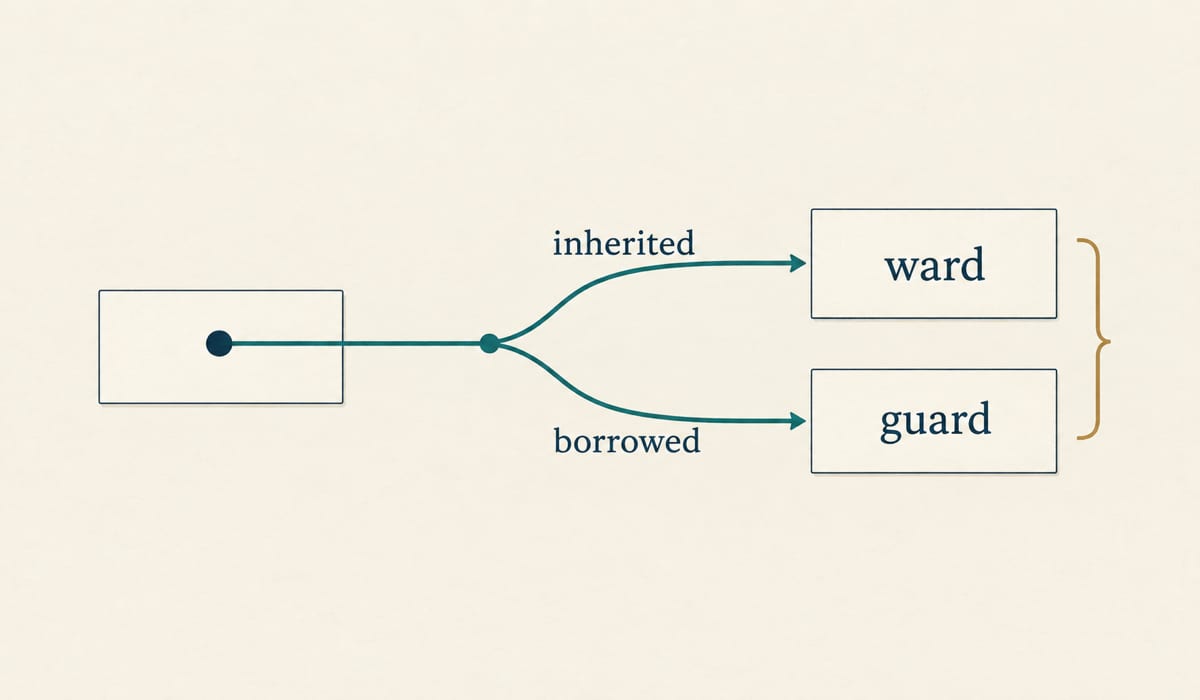
- Proto-Germanic *wardaz (noun) and *wardōn (verb)
- Inherited line: *wardaz → Old English weard → ward
- Borrowed line: *wardōn → Frankish → Old French garder → garde → guard
Royal and regal: French plain and Latin bookish
Latin regalis, “of a king,” came to English twice. The first time it came through the door of ordinary French: royal appears in Middle English in the mid-13th century from Old French roial — the spoken, everyday, worn-down shape of the word. The second time it came through the library: regal appears in the late 14th century from Old French regal and directly from Latin regalis — a form that keeps the Latin silhouette almost intact.
Both trace to rex (genitive regis), “king,” and the same PIE root *reg-, “move in a straight line,” which also produced rule and — in a nice recursive touch — royal’s own relatives. The pair survives because the two arrivals landed on slightly different jobs: royal does the common work of crowns and families, while regal stays a more deliberate, bookish adjective.
Frail and fragile: worn versus preserved forms
Latin fragilis, “easily broken” — from frangere, to break — made the same double journey. Frail arrived in the mid-14th century through Old French fraile, and Etymonline calls it “the Frenchified form of fragile”: centuries of French speech had already worn the word down before English received it. Fragile followed in the 1510s, borrowed from French fragile — or formed back from fragility — still looking almost exactly like its Latin ancestor.
The senses then did what doublet senses do: they split the workload. Both words once carried moral weakness and physical breakability — fragile’s first recorded English sense in the 1510s was “liable to sin.” Over time, usage sorted them, broadly, into the modern division where frail leans toward health and constitution and fragile toward objects that break. The drift is a convention, not a rule — Shakespeare’s “Frailty, thy name is woman” sits on the moral side of the ledger, and a fragile ego is nobody’s china.
What doublets reveal about borrowing
The quiet lesson of every doublet is that borrowing is not a single event with a closing date. Suzanne Kemmer’s Rice University chapter on borrowed words describes how loanwords arrive in waves that coincide with cultural contact — Norse settlement, the Norman influx, Latin scholarship — and how a borrowed word gradually conventionalizes until speakers no longer hear it as foreign at all. A doublet is what happens when two different waves, sometimes centuries apart, carried the same source word ashore.
That reframes a mistake it is easy to make. Seeing royal and regal together is not evidence that English “couldn’t decide” or that one form corrupted the other. Each arrival is a separate, dateable act of contact — one through spoken Norman French, one through later, more Latinate borrowing — and the pair is the record of both. The loanwords, cognates and false friends guide gives the general method for telling borrowing apart from shared ancestry; a doublet is the special case where one ancestor produced both.
Finding doublets yourself
The fastest search is literal: dictionaries flag the relationship when they know it. An Etymonline entry will often say “a doublet of x” in the word’s first paragraph — ward’s does. Merriam-Webster will sometimes note the kinship inside the etymology line. Two separate entries that end at the same source form — royal and regal both closing on Latin regalis — are the other giveaway: same ancestor, different first step.
The check has a built-in caution, though, and it is the same one from the relationship guide: resemblance plus a shared label is a hypothesis, not a result. Bat the flying mammal and bat the club look identical but arrived by different roads — the animal probably from Scandinavian, the cudgel probably from Celtic — and no reference treats them as one word arriving twice; ward and guard are. Only the documented route tells you which you have. Run each half of a suspected pair through the lookup and compare the proposed routes — where they reconverge on one form, you may be holding a doublet, and where they diverge, you have probably found a look-alike. The window example shows what a single documented borrowing looks like from the inside; a doublet is two of those chains ending at the same place.
Sources and further reading
- Online Etymology Dictionary: doublet — the term’s definition and the Century Dictionary’s typology of doublets.
- Etymonline: ward and guard — the marked doublet pair, plus the gu- note explaining the w/g split and the warranty/guarantee parallel.
- Etymonline: royal, regal, frail and fragile — the individual entries behind each pair’s two routes, and bat for the look-alike contrast.
- Rice University: borrowed words (Suzanne Kemmer) — borrowing as waves of cultural contact and the conventionalization of loanwords.
The pair analysis and the self-check method are original editorial guidance built on the linked entries. Source summaries are intentionally brief. Sources consulted 1 October 2026.