
The field’s two labels show a nice asymmetry. Loan-translation practises what it names: it was borrowed piece by piece from German Lehnübersetzung, “lend-translation,” around 1931. Calque does the opposite — it arrived whole, a straight borrowing of the French noun calque, “a copy,” from calquer, “to trace”; Etymonline dates the linguistic use to 1937. The discipline named piece-by-piece translation with one term that demonstrates it and one that just crossed the border like any other word.
Borrowing meaning without borrowing sound
An ordinary loanword imports form along with meaning: English took French beignet and kept the spelling’s French silhouette. A calque refuses the form and takes only the structure. The borrowing language looks at a foreign compound — sky plus scraper, Welt plus Anschauung — translates each piece into its own vocabulary, and reassembles the result. What crosses the border is the recipe, not the dish.
That makes a calque the stealthiest kind of borrowing. Suzanne Kemmer’s Rice chapter on loanwords describes how conventionalized borrowings stop sounding foreign to speakers; a calque never sounded foreign to begin with, because every piece in it is native. Nobody hears German in worldview, though the whole word is a translation of one.
Worldview, from German, piece by piece
German Weltanschauung — Welt, “world,” plus Anschauung, “view, contemplation” — built its reputation in philosophy as a word for a total outlook on existence. English had the concept and wanted the word. Etymonline dates worldview to 1858 and calls it “probably an Englishing of German Weltanschauung”; Wiktionary’s entry states the mechanism flatly — “a calque of German Weltanschauung, equivalent to world + view.”
Notice the honesty marker in the stronger source: probably. A calque claim is always an argument from structure — the pieces match too neatly to be independent — and good references hedge it exactly that way. Also notice the accent: English took the word’s skeleton but not German’s noun capital, its length or its philosophical register. Meaning crossed; sound stayed home.
Skyscraper’s children
The clearest calque family starts in Chicago. Etymonline’s skyscraper entry dates the word’s “tall urban building” sense to 1888 — after earlier nautical and slang meanings — and points to the French and German lookalikes for comparison. It is the Wiktionary entries that name the mechanism: French gratte-ciel is glossed “a calque of English skyscraper”: gratter, “to scrape,” plus ciel, “sky.” Spanish rascacielos is likewise “a calque of English skyscraper”: rascar plus cielos. Two languages, two scrapers, one blueprint.
German’s Wolkenkratzer shows the looser edge of the pattern: Wolke, “cloud,” plus Kratzer, “scraper” — the same image rebuilt with the nearest local materials rather than a strict piece-for-piece copy. Some references treat such near-matches as calques too; the useful habit is to ask whether the compound echoes a foreign model, not to insist that every piece align.
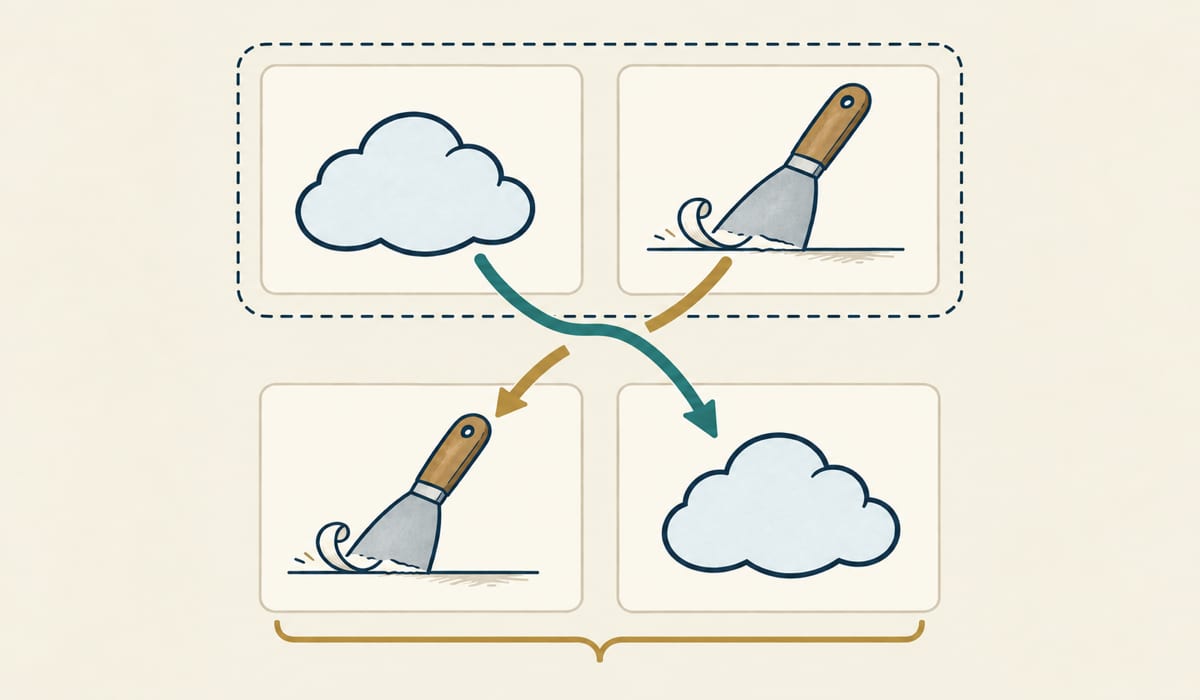
- sky → ciel; scraper → gratte
- English skyscraper (1888)
- French gratte-ciel — a calque
Calques you already use without noticing
The mechanism is older and busier than its modern label suggests. Superman is a calque built by a playwright: George Bernard Shaw coined it in 1903 to translate Nietzsche’s Übermensch — über, “over,” plus Mensch, “human” — rebuilding the German compound from English pieces where earlier translators had tried overman and beyond-man. The comic-strip hero followed in 1938.
Saturday hides a partial calque in the week itself: it is a “partial loan-translation of Latin Saturni dies, ‘Saturn’s day,’” and that Latin form was itself a loan-translation of Greek Kronou hēmera — a calque of a calque, older than English. Once you start looking, the pattern is everywhere: Etymonline says brainwashing (1950) is “said to be a literal translation” of Chinese xi nao, and masterpiece translates the guild tradition behind German Meisterstück. The words wear no foreign clothes because every stitch is local.
Why calques are hard to spot in a route
Here is the practical consequence for a generated reading. A route is drawn from recorded links — from Old French, from Latin — and a calque can leave its origin step almost invisible, because each visible piece is home-grown. Ask the lookup about worldview and an honest route may legitimately read as flat: English, made of world + view. That flat route is not wrong; it is incomplete in a specific way. The borrowing happened at the level of the compound, not the pieces.
So a thin-looking route is not automatically a failed one — it may be the footprint of a calque that only a source check can confirm. This is the mirror image of the loanwords guide: there you learn to spot words that sound borrowed; here the borrowed thing is silent. The doublets guide covers the related case where a language takes the same word twice by two routes.
Checking a suspected calque
The vocabulary is your tell. When you suspect piece-by-piece borrowing, open the word’s entries in a named dictionary and search the page for loan translation, calque, translation of or after German/Latin/French. Wiktionary marks calques explicitly at the top of the etymology; Etymonline phrases them as “an Englishing of,” “translation of” or “formed after.” Then compare the pieces: gratte-ciel only counts as evidence because gratter and ciel genuinely mean scrape and sky — the glosses are the checkable part of the claim.
Run the word through the lookup for a starting hypothesis, then do the check: if the generated account misses the foreign model entirely, that is worth flagging rather than accepting — the same skepticism the checking guide applies to any proposed route. A calque claim without a matching foreign compound is guesswork; with one, it is a documented pattern.
Sources and further reading
- Online Etymology Dictionary: calque and loan-translation — the two names for the mechanism, and the fact that one is a calque of the other.
- Etymonline: worldview and Wiktionary: worldview — the hedged Englishing and the explicit calque label.
- Etymonline: skyscraper, Wiktionary: gratte-ciel and rascacielos — the 1888 model and its French and Spanish calques.
- Etymonline: superman and saturday — Shaw’s Übermensch translation and the week’s nested loan-translations.
- Etymonline: brainwashing and masterpiece — the hedged xi nao translation and the guild tradition behind Meisterstück.
- Rice University: borrowed words (Suzanne Kemmer) — how conventionalized borrowing becomes invisible.
The framework and the checking method are original editorial guidance built on the linked entries. Source summaries are intentionally brief. Sources consulted 1 October 2026.