
A Word Says Hi reading is generated by a model and arrives as a research starting point, not verified scholarship — it carries no verified citations, so everything below is about reading the layout and then checking the claims. This guide is the annotated tour. For short answers, see Help and questions; for how a reading is produced, see How it works.
The four sections of a reading
Under your word, a reading shows a status badge — a path is suggested, some steps are uncertain or more context needed — a one-paragraph summary, and a Copy reading action that exports the same text with its labels intact. Then come four named sections: Root and language path, Meaning shifts, Related forms and Uncertainty notes, followed by a short Next steps checklist and a link to report a problem with the reading.
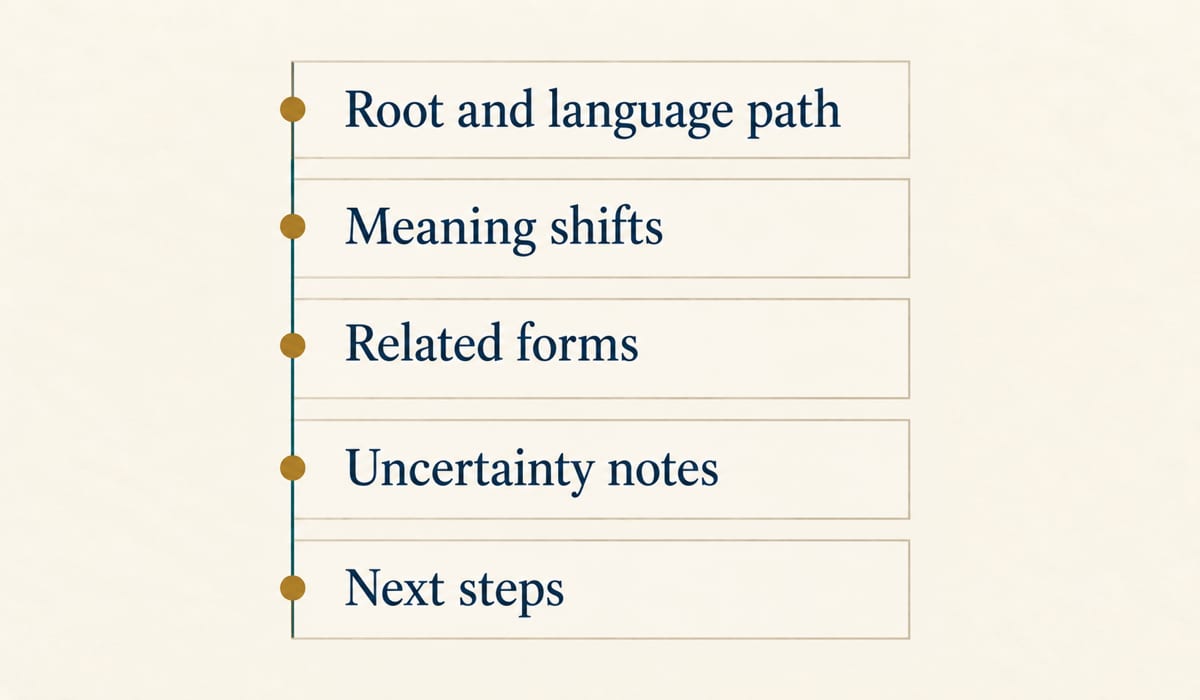
- Root and language path
- Meaning shifts
- Related forms
- Uncertainty notes
- Next steps
None of the four sections is a citation. Each is a claim the model produced for you to inspect. The difference between this reading and a dictionary entry is the difference between a proposal and a record — keep that distinction in front of you as you read down the page.
If you want to see the layout before spending a lookup, the home page offers morrowkin, an invented example reading that opens without sending anything. It wears a visible “invented word · example only” banner, its footnote says the forms are not a historical route, and its verification note admits there is nothing to check — it exists purely to show how a real reading is organized. For a live tour, run coffee through the lookup and follow along here.
Under every real reading, the page repeats the product’s boundary in a sentence worth reading once: generated word histories are not verified scholarship — check each proposed form, date, and language link in historical dictionaries and dated texts before relying on it.
A route is a proposed sequence, not a map
“Root and language path” opens with three fields — source language, root form and root gloss, plus a pronunciation when one is returned — then lists the proposed earlier forms as an ordered path. Each step shows a language, a form, a short gloss, a period when the model supplies one, and an evidence word: Reported step or Uncertain step.
Those labels are the model’s own assessment, printed beside the step rather than hidden — the footnote under the path says so plainly. “Reported” means the model is asserting this link as reported, not that an editor verified it. And the sequence is semantic, not geographic: an arrow from an Arabic form to a Turkish one is a claimed language link, not a ship’s itinerary. A dictionary etymology line makes the same kind of claim in its own notation — how to read a dictionary etymology entry decodes that format so you can compare the two directly.
Try it on tea: the proposed path will look tidy, and the source-linked tea page shows why tidy needs checking — that word reached English twice on different routes.
Meaning shifts and their labels
The meaning list records the senses the model proposes the word picked up, each with a context note and an evidence label — Model-reported or Uncertain. A shift describes how a meaning is claimed to have moved, not when. An empty section is also a result: it means the model proposed no shifts, not that the word never changed.
Read each shift as a hypothesis about sense. Does a dated record show the new meaning in use? Does an older sense survive beside it? How word meanings change shows how to compare senses without erasing either. Run quarantine — from forty days to general isolation — and watch how one label sits under each proposed shift.
Why related forms are suggestions, not submissions
“Related forms” lists nearby words the model judged connected — a source form, a cognate, a derivative — each with its language and the claimed relationship. Every row carries a Use this word action. It copies that word into the lookup field and nothing more: the button does not send a request, and the reading states this underneath the list. A lookup happens only when you submit the form yourself.
Treat each related form as a lead. The model’s claim that two words are related is exactly the kind of statement a dictionary can confirm or quietly fail to mention. Try orange: its curated page shows how a genuine related-forms chain reads when every step is tied to a cited entry.
Reading the uncertainty notes
The uncertainty section is the part other tools leave out. It lists, in plain sentences, where the model’s account is thin: a step with no attested intermediate, a date that may be approximate, a competing account the route diagram cannot show. When the model is confident, this section may say little; when it is not, the notes are the most honest sentences on the page.
Read them before you read the route. An uncertain step is not a failed lookup — it is the useful part, the place where your own checking should start. If the notes seem to contradict the confident tone of the summary above them, trust the notes.
What a lookup sends
Submitting the form sends your word — and your language hint if you filled one — through this site’s Cloudflare Worker to Qomza’s analysis gateway, along with technical request metadata: the IP address Cloudflare sees for your connection, an approximate browser language preference, a per-request identifier and app details. The gateway keeps the request and its response in its records; they are not deleted automatically. Nothing is sent while you type or when you press “Use this word.” The Privacy page has the full disclosure in one place.
From reading to checking: your next three clicks
Every reading ends with the same three-step checking list, and it is the point of the page. First, check each proposed form and date in historical dictionaries and note which steps the reference itself calls uncertain. Second, look for dated texts that use the form or meaning, and read them in context. Third, compare each language link against an independent reference — similar spelling alone does not establish a connection.
If your word matches one of the ten curated pages, the reading offers a direct link to its source-linked example. Otherwise the word origin research guide turns the three clicks into a reusable method, and how to check an AI-generated etymology covers the three error shapes to look for first. A good reading is the one that hands you a clear question.
Sources and further reading
- Merriam-Webster explanatory notes: etymology — the reference-notation counterpart of the route section’s claims.
- Essentials of Linguistics: reconstructing the past — the method behind the language links a reading proposes.
The section-by-section tour is original editorial guidance describing the implemented result view. Sources consulted 29 September 2026.