orange

ˈär-inj

A citrus name crossed Sanskrit, Persian, Arabic, Occitan and French before English — and named the colour after the fruit.

Try orange in the lookup
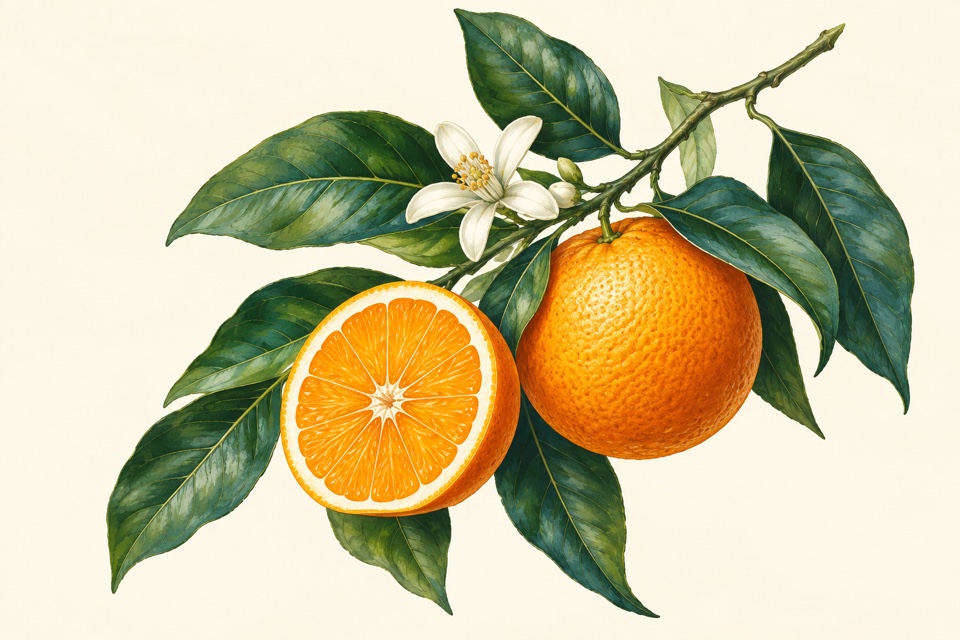
Whole and sliced orange with deep green leaves and a small white blossom.
Decorative illustration

One possible route

The sequence below follows the cited Merriam-Webster entry.

A word routeLanguage forms named in the cited Merriam-Webster entry
  1. Sanskritnāraṅgaorange tree — of uncertain origin
  2. Persiannāranga form carried into Arabic
  3. Arabicnāranjthe source for Old Occitan
  4. Old Occitanauranjathen Anglo-French orrange
  5. English noun · sense 2orangetrees or fruits resembling the orange (Merriam-Webster)1532
  6. English adjective · sense 1orangeof or relating to the orange (Merriam-Webster)1542

A citrus name crosses languages

Merriam-Webster traces the noun from Sanskrit nāraṅga (“orange tree”) through Persian nārang, Arabic nāranj, Old Occitan auranja and Anglo-French forms. It dates noun sense 2, for trees or fruits resembling the orange, to 1532 and adjective sense 1, “of or relating to the orange,” to 1542. The Online Etymology Dictionary already records the fruit word in late 14th-century English; the American Heritage Dictionary calls the Sanskrit form “possibly of Dravidian origin,” where Etymonline settles for “a word of uncertain origin.”

This page summarizes the cited dictionary entries. Follow each source for its full wording, notes and references.

More from the cited entries

Word-specific details from the linked dictionaries, with the dictionary named beside each claim.

The fruit named the colour

English had the fruit before it had the colour. The Online Etymology Dictionary dates the colour word to the 1510s — “a reddish-yellow color like that of a ripe orange” — and notes that Middle English called similar colours citrine or saffron. The American Heritage Dictionary likewise puts the colour use in the 16th century.

So the popular shortcut “the colour is named after the fruit” is directionally right in the two dictionaries that date it: the Online Etymology Dictionary and the American Heritage Dictionary each put a colour use later than a fruit use, while Merriam-Webster gives no date for the colour sense. The dated records still differ — late 14th century for the fruit in Etymonline, around 1400 for the first orenge spelling in AHD's account, and Merriam-Webster's 1532 and 1542 for two other named senses — so no single “first orange” date is claimed here.

Where the first n went

The older forms keep an n that English lost: Italian narancia (Venetian naranza) stands behind Old French orange, and Arabic nāranj behind that. The Online Etymology Dictionary explains the loss as probably misdivision — une narange heard as une orange — possibly helped along by French or, “gold.”

The same kind of redivision appears inside English itself: Etymonline's adder entry, linked from this one, records a nadder re-cut into an adder — the n again moving off the noun — alongside apron, auger and umpire. The mechanism is documented; which forms it touched exactly where is the kind of detail dictionaries flag as probable rather than certain.

A town caught in the story

Orange, the town on the Rhône, keeps turning up in this word's accounts. The American Heritage Dictionary says the a of the Old Italian form was replaced by o in Old French under the influence of the town's name — “from which oranges reached the northern part of France” — and possibly also Old French or, “gold.” The Online Etymology Dictionary shades it differently: Roman Arausio has “no obvious association with the fruit” beyond lying on the road from Marseilles to Paris along which masses of oranges were carried north, and it suggests the town's name may itself have been deformed toward the fruit's.

The town's name also carried into politics: the Online Etymology Dictionary records the Orangemen as the 1795 Belfast society named for William of Orange — later King William III of England — of the German House of Nassau, a documented name link that belongs to the town, not the fruit. Bitter and sweet oranges have their own documented names too: the same entry notes that only Modern Greek still seems to distinguish the bitter nerantzi from the sweet portokali, “Portuguese,” after the traders who brought sweet oranges from India to Europe in the 15th century.

Keep following words

Continue with another source-linked example.

All ten examples