
A borrowed word is a record of contact, and for everyday goods the contact was usually commercial. The dictionary’s chain — from Dutch, from Turkish, from Arabic — often shadows the markets and shipping lanes the goods moved through. One caution up front: the chain documents the word’s journey between languages, not the itinerary of any particular crate — it is evidence about transmission, not a bill of lading. That chain is what the loanwords guide calls borrowing; this guide follows what borrowing looks like when the borrower was buying cargo.
The cargo carries the name
Trade gives a word its ticket. A merchant who buys a commodity usually picks up the local name with it — the seller’s word is the one the buyer hears, and often the one that travels on. English rarely translated the names of new imports: it took the word the seller used, let English mouths reshape it, and kept trading. So a goods word’s etymology tends to run backwards through the languages of the traders who carried it — English ← the trading power that imported it ← the producers and intermediaries before them.
The result is a particular signature: the last language in the chain is usually a commercial one (Dutch, French, Italian — whoever ran the importing), while the deepest names often point at where the thing grew or was made. The word is a fossil of that passage between languages — the chain records the word’s route; the cargo’s matching itinerary is the usual inference, not something the chain alone proves.
Tea: two roads, two pronunciations
Tea shows the pattern twice, because the commodity reached Europe by two competing roads and brought two pronunciations with it. The Online Etymology Dictionary’s tea entry traces one family through Mandarin ch’a — carried overland and by Portuguese traders through Macao — which survives as cha, chai and relatives across Asia and in English’s own early chaa (1590s). The other family went to sea: the Dutch East India Company began shipping tea in 1610, taking the word from Malay teh, itself from a Min Chinese dialect form — and Dutch thee became English tea in the 1650s.
Which pronunciation a language wears still marks which road the word arrived by: the ch- forms mark the overland and Portuguese paths, the t- forms mark the Dutch sea route into northwestern Europe. Two words for one plant, sorted by shipping lane — the full account is on the tea page.
Coffee and sugar: Arabic and Persian through the ports
Coffee carries the Middle Eastern café chain in its letters: Etymonline runs English coffee (c. 1600) through Dutch koffie ← Turkish kahveh ← Arabic qahwah, with the plant itself native to Arabia and Ethiopia. The early English spellings — chaoua (1598), cahve — show buyers still writing the word as they heard it in Turkish and Arabic ports before the Dutch import trade settled the form. By 1650 it was in England; by 1675 the country held more than 3,000 coffee houses. The coffee page keeps the dictionaries’ differing last-hop accounts side by side.
Sugar is a longer caravan: Etymonline’s entry runs English sugre (late 13th century) ← Old French sucre ← Medieval Latin succarum ← Arabic sukkar ← Persian shakar ← Sanskrit sharkara — “ground or candied sugar,” and originally “grit, gravel.” The chain retraces the cultivation route west: the crop was India’s, the Arabs carried it to Sicily and Spain, and only after the Crusades did it begin to rival honey as Europe’s sweetener. Each language name marks a hand the word passed through; where the cultivation history is documented, the commodity itself largely followed.
Orange: a fruit’s long manifest
Orange travelled so well it arrived before its color. Etymonline’s orange entry traces the fruit word (late 14th century) ← Old French orange ← Medieval Latin pomum de orenge ← Italian arancia — originally narancia — ← Arabic naranj ← Persian narang ← Sanskrit naranga-s, “orange tree.” The initial n- was probably lost to article confusion — une narange re-heard as une arange, the same boundary error that turned a nadder into an adder — though the entry also allows influence from French or, “gold.”
The fruit’s itinerary is in the word’s wear. Bitter oranges were already grown in southern Europe after an eleventh-century introduction into Italy; sweet oranges reached Europe in the fifteenth century with Portuguese traders and displaced them — Modern Greek still calls the sweet one portokali, “Portuguese.” Sailors planted citrus along the routes against scurvy. And English did not call the color orange until the 1510s: the cargo named the color, not the other way round. See the orange page for the sourced account.
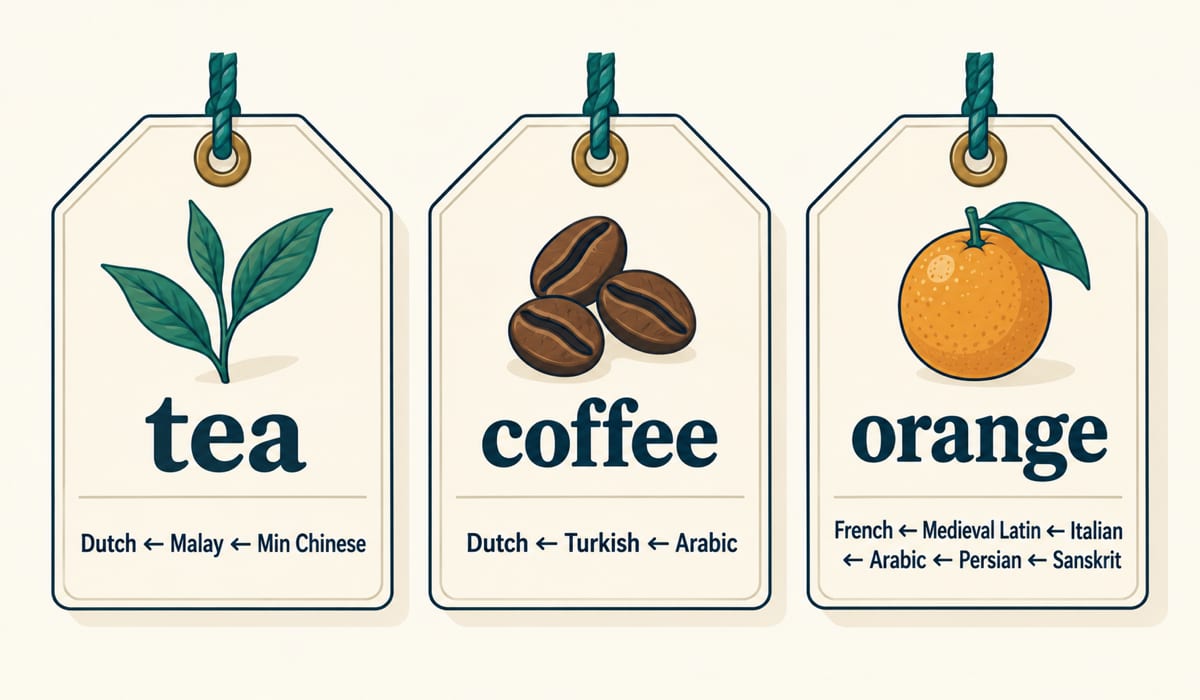
- tea: Dutch ← Malay ← Min Chinese
- coffee: Dutch ← Turkish ← Arabic
- orange: French ← Medieval Latin ← Italian ← Arabic ← Persian ← Sanskrit
What trade words share
Set the examples side by side and the pattern repeats: the word arrives in English close to when the goods arrive; the last hop is a trading power’s language; the early spellings scatter (chaoua, cahve, kahui) before print and habit settle them; and the name usually stays the seller’s name, untranslated. Where two routes compete — tea’s ch- and t- families — the language can keep both and let usage sort them.
Ketchup shows the honest edge of the pattern. Etymonline’s entry has English picking the word up in the 1680s — the era of the East Indies sauce trade — and then lays out the deep-origin candidates without pretending to a verdict: possibly a Malay fish-sauce name, possibly from a Chinese dialect word for fish brine, with other theories competing. The tomato version is a later American development, and the entry’s hedges mark where the record thins. Even the word for the toll on all this cargo — tariff — travelled the same way, reaching English in the 1590s from Italian tariffa, ultimately from Arabic. When the route fog is genuine, the good entry says so. The uncertainty is the record.
Following the route in a dictionary
To read a trade word’s route, read the chain as a sequence of hands rather than a single “origin.” A bare “from Dutch” is the last seller, not the grower; “ultimately from” signals skipped intermediaries — the dictionary-entry guide covers that notation. Then check the chain’s plausibility: does each named language fit a plausible hand-off for the word at that date? A chain that jumps from Sanskrit to London with no middlemen is missing slips. And keep the two claims separate: the language chain is dated evidence about the word’s transmission; that the cargo itself took the same road is the usual inference, not something the chain alone proves.
More candidates to try: saffron, pepper, silk, ginger, cotton — each moved along routes like these. Run one through the word lookup and compare the generated route with a dated entry: a reading is a research starting point, and trade words are the perfect test of whether its chain names languages in the order the word plausibly travelled.
Sources and further reading
- Online Etymology Dictionary: tea — the two transmission routes, Mandarin ch’a overland and the Min/Malay/Dutch sea route.
- Online Etymology Dictionary: coffee — the Dutch ← Turkish ← Arabic chain and the coffee-house timeline.
- Online Etymology Dictionary: sugar — the Sanskrit-to-English chain along the cultivation route.
- Online Etymology Dictionary: orange — the lost n-, the Portuguese sweet orange and the late color use.
- Online Etymology Dictionary: ketchup — the 1680s arrival and the honestly hedged deep origin.
- Online Etymology Dictionary: tariff — the 1590s arrival from Italian tariffa, ultimately Arabic.
The trade-route framework and the checking steps are original editorial guidance. Source summaries are intentionally brief. Sources consulted 1 October 2026.