
Start with the assumption that both entries are competent. Lexicographers read the same record and can still weight it differently, so a disagreement between reputable dictionaries is information about the evidence, not a coin flip about who to trust.
Three dictionaries, three accounts of coffee
Open coffee in three references and the disagreement is concrete. Merriam-Webster opens its etymology “Italian & Turkish” — naming both languages as possible immediate sources — then traces Italian caffè, from Turkish kahve, from Arabic qahwa. The Online Etymology Dictionary hands the last step to Dutch koffie. The American Heritage Dictionary describes an alteration of Ottoman Turkish qahve under Italian influence. All three agree on the deep history — Arabic qahwa into Turkish — and part company on which language passed the word to English.
| Reference | The step it gives into English | Date line |
|---|---|---|
| Merriam-Webster | Italian caffè or Turkish kahve directly — the entry names both as possible sources | 1598, first noun sense |
| Online Etymology Dictionary | Dutch koffie, from Turkish kahve | c. 1600 |
| American Heritage Dictionary | Alteration of Ottoman Turkish qahve, influenced by Italian | No date line in the entry |
Our coffee example page keeps all three accounts side by side rather than silently picking one. The rest of this guide explains why such splits are normal.
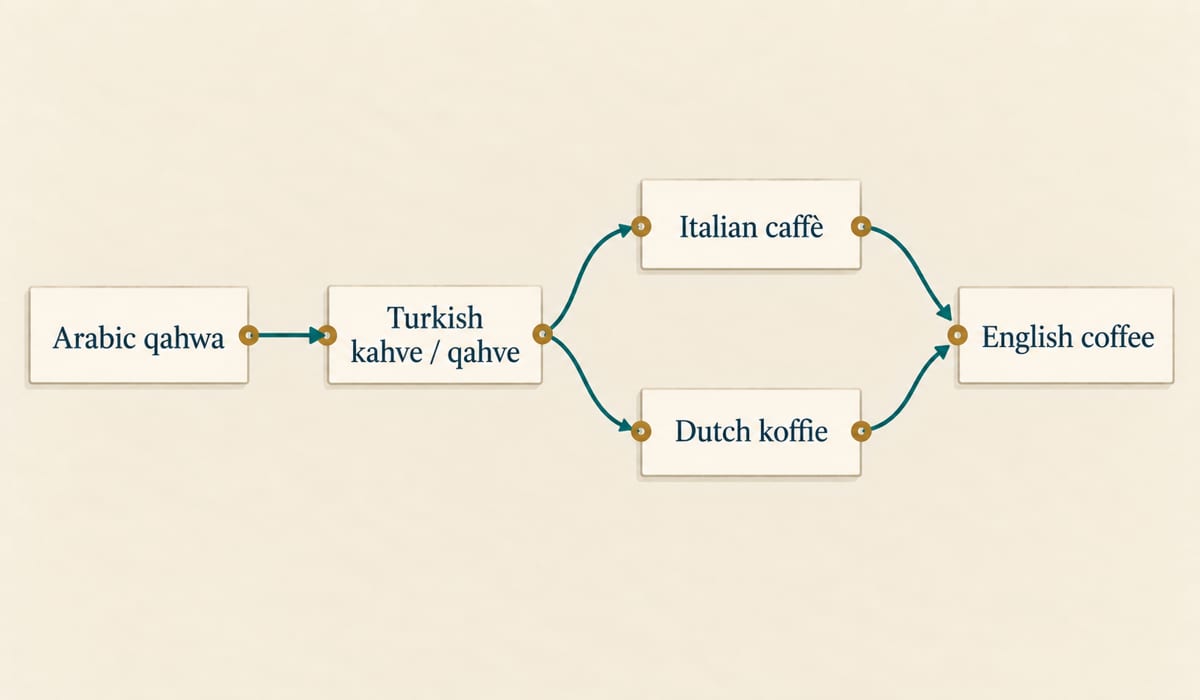
- Arabic qahwa
- Turkish kahve / qahve
- Italian caffè or Dutch koffie
- English coffee
Reason 1: the evidence record has gaps
A word’s path is reconstructed from surviving documents, and survival is uneven. A language can hand a word over in speech long before anyone writes it down; the written record starts where the paper does. Where evidence is missing, dictionaries must bridge the gap with judgement — and different editors bridge differently.
This is why coffee’s last step is contestable: the early English spellings — chaoua, cahve, kahui — point at the Arabic or Turkish forms without settling which European language transmitted them. When you meet a gap-driven disagreement, the honest version names both proposals and the missing evidence between them.
Reason 2: two routes can both reach English
Sometimes the disagreement is not over a gap but over a real fork: the same source word reached English twice by different roads, or reached different speakers differently. Tea is the clean case — English knew chaa spellings in the 1590s through Portuguese by way of Macao, while the modern tea reflects the Amoy-dialect form carried by Malay and probably Dutch traders. One Chinese word, two ports, two spellings, and a dictionary has to choose which thread to follow — or show both. Asking which route “the word” took has no single answer; it depends which form and which century you mean.
For words like this, the entries are not contradicting each other so much as describing different parts of one story. Check whether each dictionary is even talking about the same form before you call it a disagreement.
A word about algorithm
Algorithm shows both mechanisms at once. Its English form descends from a medieval Latinisation of al-Khwārizmī’s name — that part is stable across references — but its spelling was remodelled under the influence of Greek arithmos and arithmetic, and the dictionaries date different senses to different centuries: the Online Etymology Dictionary reaches the 1690s for one sense while Merriam-Webster dates the modern mathematical sense to 1811. Same headword, two clocks.
Reason 3: conventions differ (dates, senses, grouping)
The most invisible source of disagreement is convention: what each dictionary counts, and at what granularity. Dates are the usual casualty. A first-use date is always scoped to a sense and to the reference’s own evidence work — algorithm carries a 1690s date in the Online Etymology Dictionary’s account and an 1811 date in Merriam-Webster’s, because the two entries are dating different senses of the same spelling. First recorded use and word invention covers this scoping in detail.
Entries also differ in how they group a history: one may fold an intermediate language into “influenced by” while another grants it a full step. Read the whole etymology note, not just the language list — the qualifiers are where the conventions live.
So which account should you trust?
Usually neither needs to “win.” When the disagreement is a gap, the trustworthy answer is the one that names its evidence and hedges where the record thins — prefer the account that admits “probably” over the one that asserts silently. When it is a fork, both accounts may be right about different forms or centuries, and trusting the question is more honest than trusting either answer. When it is convention, trust each source about what it counted and stop expecting them to agree about something they never measured the same way.
If you must pick one for a citation, prefer the entry whose scope matches your claim — the dictionary that dates the sense you are writing about beats the one that dates a different sense more loudly.
How to report a disagreement honestly
When you write up a split, give each account its own sentence and its own source. “Merriam-Webster offers both Italian and Turkish as the immediate source; the Online Etymology Dictionary routes the word through Dutch” is a complete and accurate report. Resist flattening them into a merged chain — the blended version is a third account that no source supports.
Keep the scope marks attached: which sense, which spelling, which date convention each source used. And if the references are themselves tentative — a “probably,” a “perhaps,” an “alteration influenced by” — carry the hedge. The hedge is part of the claim.
The same discipline applies to generated output: when a Word Says Hi reading proposes a route, treat it as one account to set beside the dictionaries, not above them. If a reference disagrees with the generated chain, the reference wins until evidence says otherwise — the reading’s job was to hand you the question.
A disagreement is a finding, not a failure
Notice how the three worked cases line up with the three reasons. Coffee’s split is a gap — the early spellings never settled which language handed the word over. Tea’s is a fork — two real routes, both attested, arriving in different centuries. Algorithm’s is convention — two clocks running on different senses of the same spelling. When you meet the next disagreement, the first diagnostic question is which of the three you are looking at, because that decides what further checking can and cannot settle.
A resolved word history is satisfying, but an unresolved fork is still a correct result: it tells you where the record thins and which questions remain. When you check a generated reading — ours or any tool’s — treat one clean chain as a prompt to open a second dictionary, not as a finished answer. If the two accounts diverge, you have learned something a single entry would have hidden. How to research a word origin shows how to keep the parallel accounts in one evidence record.
Sources and further reading
- Online Etymology Dictionary: coffee — the Dutch-route account of the last step.
- American Heritage Dictionary: coffee — the Ottoman Turkish alteration under Italian influence.
- Merriam-Webster: coffee — the entry that names Italian and Turkish as possible sources, plus a sense-scoped first-use date.
The disagreement framework and reporting practice are original editorial guidance. Source summaries are intentionally brief. Sources consulted 30 September 2026.