
Short answer: Shakespeare almost certainly coined some words — a working dramatist stretches the language — but the popular claim systematically confuses “earliest example anyone has found” with “first person ever to say it.” The confusion flatters him, and the real record is more interesting.
Where the 1,700 number comes from
The figure is a citation count wearing a coinage costume. When people tot up the words for which Shakespeare supplies the Oxford English Dictionary’s earliest quotation, the tally lands somewhere near 1,700 — and the number then gets re-told as “words Shakespeare invented.” The University of Waterloo’s Life of Words project, which studies Shakespeare’s earliest OED citations, puts the distinction plainly: he is credited with being the first to put a word on paper a whole lot, “this is not the same as inventing a word, though probably he did that too.”
It is undeniably a lot of firsts. On raw earliest-citation counts Shakespeare trails only three late-medieval sources — Cursor Mundi, Chaucer and Wyclif — and on earliest citations for a new sense of an existing word he leads the field by a large margin. That second category is worth noticing: much of his documented “invention” is actually recorded sense-stretching — an old word doing new work. Waterloo’s analysis is drawn from the first edition of the OED, published in 1928, while noting the picture is much the same in the 1989 second edition; the ongoing third-edition revision is a different beast, and any count attached to it will move as antedatings keep arriving.
First citation versus actual coinage
An earliest citation tells you the earliest example a dictionary’s readers happened to preserve. It is a fact about evidence. A coinage claim is a fact about a mind: this person made the word. One can sit on top of the other — occasionally they coincide — but they are different claims needing different evidence. The first-recorded-use guide teaches the general distinction; Shakespeare is its most inflated case.
The practical test: for a documented coinage you expect some trace of the act — a writer flagging the novelty, a definable moment, a word built on a pattern the author visibly plays with. None of that is what an OED date line reports. A date line reports the earliest slip in the file.
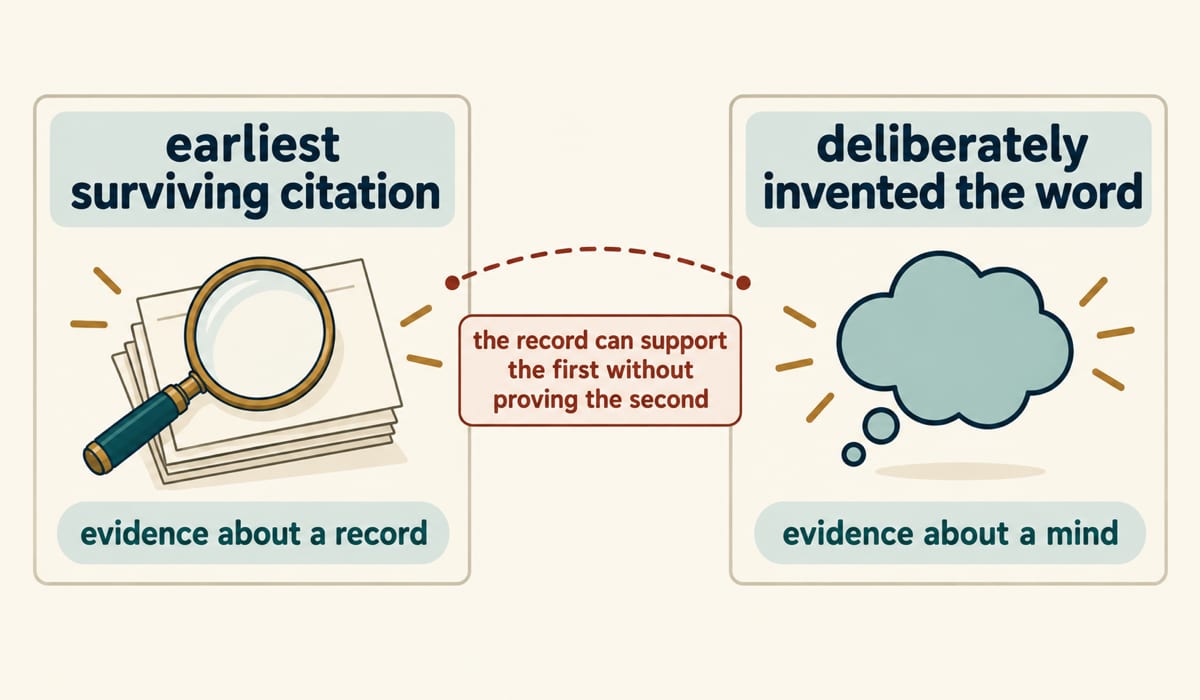
- earliest citation found: evidence about a record
- deliberately coined: evidence about a mind
- the record can support the first without proving the second
What the OED record really shows
Look at how the evidence was gathered. The first edition of the OED was built from more than five million slips — Oxford University Press Archives describes quotation slips collected by volunteer readers combing published material between 1857 and 1928. An “earliest citation” is the earliest slip those readers happened to file, from the books they happened to read.
And when Waterloo’s analysis stops counting raw firsts and instead measures the share of each work’s quotations that are earliest citations, the picture inverts: comparable plays by Jonson, Greene, Marston and others show higher proportions of first-use documentation than most of Shakespeare’s works. His lead in raw counts tracks his lead in total citations — the more a work is cited, the more earliest citations it furnishes. Shakespeare looks like the great inventor partly because the dictionary’s readers looked at Shakespeare the most.
Why attribution gets inflated
Three biases stack the count. Survival: Shakespeare’s works stayed in print and on stage while many contemporaries’ pamphlets, sermons and drafts did not survive at all — the record preserves his words better than his neighbors’. Search: the nineteenth-century compilers worked from printed concordances, and Shakespeare’s works were among the most concorded texts in English, so his vocabulary was the easiest vocabulary to cite. Prestige: a famous name makes a quotation worth printing — Waterloo’s analysis notes that single-citation entries quoting literary works tend toward nonce uses, and scholars have long suspected some were recorded partly on the author’s prestige.
Add the storyteller’s incentive — “Shakespeare invented this word” is a better sentence than “Shakespeare’s works contain the earliest located example” — and the number inflates at every retelling. A speech community invents most vocabulary anonymously and out loud; a playwright is simply the person whose version of the language got printed, reprinted and indexed hardest. Meanwhile the dictionaries themselves make no such claim: Merriam-Webster’s account of how a word enters the dictionary describes editors accumulating citations of a word in use — recording usage, not crowning inventors.
Other ‘famous inventor’ claims that shrink on inspection
Shakespeare is the extreme case of a general pattern: any famous writer can collect credit for being first in the surviving record. Chaucer, Milton and Dickens each carry their own lists of “words they coined,” and each list shrinks the same way once you ask what “coined” would take to prove. Even within Shakespeare’s own numbers, Waterloo’s breakdown shows the lead lives mostly in the raw counts, not in the rate of first-citation evidence — and the counts themselves keep moving, since every new antedating quietly retires another “first.”
The correction is not “he invented nothing.” It is that the public number answers a different question than the one being asked — and for some individual words the honest answer is even better than the myth: nobody knows who first said it, and Shakespeare is simply the earliest surviving witness. The witness is real information — the citation still tells you when the word was circulating in print — which the myth throws away.
How to phrase it honestly
The accurate sentence takes one extra clause: “the earliest surviving example the OED’s editors found is in Shakespeare.” That credits what is documented — the citation — without asserting what isn’t — the act of invention. If you want the stronger claim, look for what would support it: a contemporary noticing the novelty, a visible word-building act, a usage that only makes sense as a coinage.
The same sentence scales to every famous-name claim: “earliest located example in X’s works” is the checkable form of “X coined it,” whatever the writer. It is also the right way to read a generated history. Run a celebrated “Shakespeare word” through the word lookup and check whether the reading repeats the invention claim or qualifies it with the citation evidence — a reading is a research starting point, and this is exactly the kind of claim where starting point and verdict drift apart. The myth-checking guide covers the general pattern; for a genuinely documented coinage to compare against, the serendipity example shows what a real inventor-attribution looks like when the record supplies one.
Sources and further reading
- The Life of Words, University of Waterloo: Shakespeare’s earliest OED citations — the first-citation counts, the comparison with other dramatists, and the citation-versus-invention distinction.
- Oxford University Press Archives: OED slips — the five million reader-collected quotation slips behind the first edition.
- Merriam-Webster: how does a word get into a dictionary — dictionaries accumulate evidence of use; they do not certify inventors.
The citation-versus-coinage analysis and the phrasing guidance are original editorial guidance. Source summaries are intentionally brief. Sources consulted 1 October 2026.