
Dictionaries are evidence, not verdicts — and occasionally the evidence contains its own typos. A ghost word is an entry pointing at nothing: a headword that exists because someone misread a note, misfiled a slip, or — more rarely — planted a fake on purpose. The record has errata; the errata make the best stories.
Dord: the slip that became a word
On 31 July 1931 the dictionary’s chemistry editor, Austin M. Patterson, sent in a slip reading “D or d, cont./density” — a note that the letter d, capitalized or not, should join the list of words the letter can abbreviate. Somewhere between the slip and the printed page the spaces vanished — headwords were typed with spaces between the letters, so “D or d” looked very much like “D o r d” — and the note was read as a single word. It entered the second edition of Webster’s New International Dictionary in 1934 as a noun meaning density.
The Wikipedia entry on dord and Snopes’ check of the story — which rates the account true — reconstruct the same sequence: an editor noticed on 28 February 1939 that the word carried no etymology, traced the slip, and an order went to the printer marked “plate change/imperative/urgent.” Bound copies without the ghost appeared from 1940, yet it lingered on page 771 — between Dorcopsis and doré — in printed copies well into the 1940s and was not completely removed until 1947. The editor who later documented the error, Philip Babcock Gove, allowed himself one regret: “why shouldn’t dord mean ‘density’?” Merriam-Webster’s own telling calls it a ghost word outright.
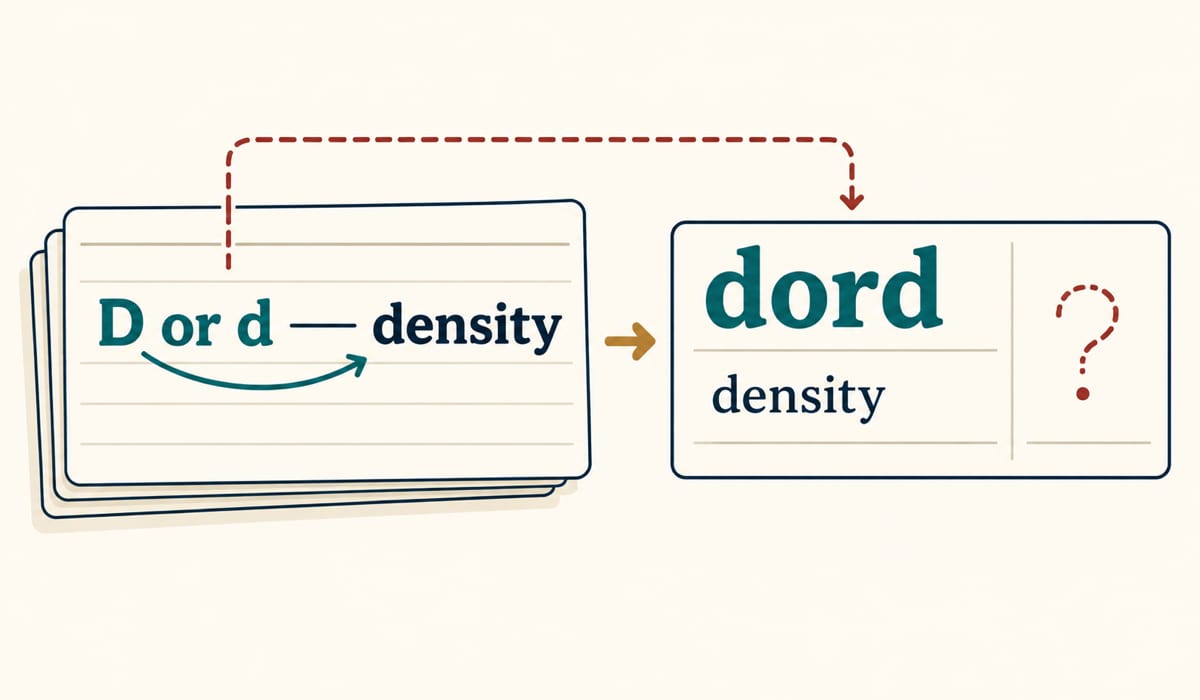
- a slip notes that D or d abbreviates density
- the note is misread as one word, dord
- the entry is printed and given a definition: density
How the error survived five years
Nothing about the entry advertised its emptiness. The original slip went missing, so a replacement slip was prepared for the printer that assigned the would-be word a part of speech and a pronunciation — and the entry that resulted was not questioned or corrected by the proofreaders. It sat alphabetically correct between Dorcopsis and doré, wore a plausible n., and answered a question almost nobody asked — who looks up density’s abbreviation? The failure was not exotic; it was the ordinary accumulation of trust. The slip was trusted, the typesetting was trusted, the printed page was trusted, and every reprinting laundered the mistake a little further into “it must be real, it’s in the dictionary.”
That is the mechanism worth remembering, because it has nothing to do with dictionaries specifically: an error that reaches a trusted format gets repeated as fact. The word’s authority was borrowed from the page around it, not earned by any usage — dord had no quotations, no etymology and no life outside the entry.
Esquivalience: the deliberate fake
Where dord was an accident, esquivalience was a trap. The New Oxford American Dictionary’s second edition (2005) carries an entry for it — “the willful avoidance of one’s official responsibilities” — that does not correspond to any real word. As The New Yorker’s “Not a Word” reported, the fabricated entry had been planted in the first edition to protect the dictionary’s electronic text: any rival product that reproduced it had obviously copied NOAD rather than the language.
The trap was not actually built to be seamless. NOAD’s editor-in-chief Erin McKean told The New Yorker the editors “wanted something highly improbable” — “a word that could not arise in nature” — and conceded a genuine formation would probably lack the l. Senior editor Christine Lindberg coined it anyway, and it still did its job twice over: most of the consulted experts smelled something off (“it’s just trying a little too hard”), yet the entry propagated onto Dictionary.com regardless. The lesson inverts the obvious one — a fake does not have to be plausible to survive; it only has to sit unexamined between trusted neighbors.
Mountweazels and copyright traps
The practice has a name: a mountweazel, after Lillian Virginia Mountweazel, a fictitious photographer given a biography in the 1975 New Columbia Encyclopedia for the same purpose — to expose wholesale copying. The more general term is a fictitious entry or trap entry, and mapmakers and directory publishers have long used the same device. They answer a real legal problem (a dictionary of a language cannot be copyrighted word by word, so a copied entry is hard to prove) while creating a strange side effect: the trusted text deliberately contains a lie.
The New Yorker piece pairs esquivalience with the Mountweazel precedent, and it is worth separating the two kinds of ghost. An accidental ghost like dord is a defect. A trap entry is a feature — for the publisher. For the reader both look identical: an entry that answers to no usage.
Once noticed, both kinds stop working. Dord was excised with an urgent plate change; esquivalience was publicly named by its own editor as the plant it was. A ghost word is durable only while nobody is checking — which is why the check, not the authority, is the real protection.
What ghost words teach about trusting a single source
The ghost words’ real lesson is not “dictionaries lie” — it is that a single authoritative source is still a single source. Dord survived because nobody cross-checked an abbreviation note against a second reference; esquivalience propagated into another dictionary despite its deliberately odd form — and was exposed as soon as lexicographers were asked to look at it. The fix in both cases is the same move the site teaches everywhere: open a second independent reference, and watch for the entry that exists in only one.
Generated word histories raise the stakes one notch further. A model can repeat a ghost-word entry as confidently as a real one — or invent a plausible-looking step of its own, the error shape covered in how to check an AI-generated etymology. Authority, fluency and print-quality confidence are all orthogonal to whether a word was ever used.
A habit that would have caught dord
You do not need an archive to apply the check. When an entry matters to you — for a citation, a claim, a decision — ask three things of it: Does it carry an etymology line or dated quotations, the parts of an entry that point back into the record? Does a second, independent dictionary recognize the word at all? And does anything outside reference books — usage in print, in speech, in records — attest it? Dord fails all three: no etymology, no quotations, no usage. That is what a ghost looks like once you ask.
The companion habit is the honest one: when you cannot find evidence, say so rather than rounding up to a real history. The research guide builds a record field for exactly that limit, and it is the stance the word lookup is designed to model — a reading should mark a step it cannot support rather than invent the support.
Sources and further reading
- Wikipedia: Dord — the 1931 slip, the 1934 entry, the 1939 discovery and the removal chronology.
- Snopes: ghost word — an independent check rating the dord story true.
- The New Yorker: “Not a Word” — esquivalience, Christine Lindberg and the Mountweazel precedent.
- Merriam-Webster: dord, a ghost word — the publisher’s own account of its most famous slip.
The ghost-word classification and the checking habit are original editorial guidance. Source summaries are intentionally brief. Sources consulted 1 October 2026.