
A blend is a word built from pieces of two other words — usually the start of the first and the end of the second — so that the new word carries a compressed version of both meanings. Linguists also call the result a portmanteau word. It is one of the few word-building tricks English speakers perform consciously, and one of the few whose name is itself a documented joke by a famous writer.
Smoke plus fog: the basic mechanism
Smog is the textbook case. It keeps sm- from smoke and -og from fog, and the combined word names the combined thing: smoke thickened with fog hanging over a city. The Online Etymology Dictionary’s smog entry dates the word to 1905 and notes it was coined “after Lewis Carroll’s example” — first printed in a report of a paper on London’s air that Dr. H. A. des Voeux read to a public-health congress.
Notice what a blend is not. It is not a clipping, which drops part of a single word (as exam drops the rest of examination). And it is not a prefix or suffix attaching to a stem. A blend takes material from two independent words and leaves each parent shortened. Both donations matter: smog without the fog is just smoke with a strange spelling.
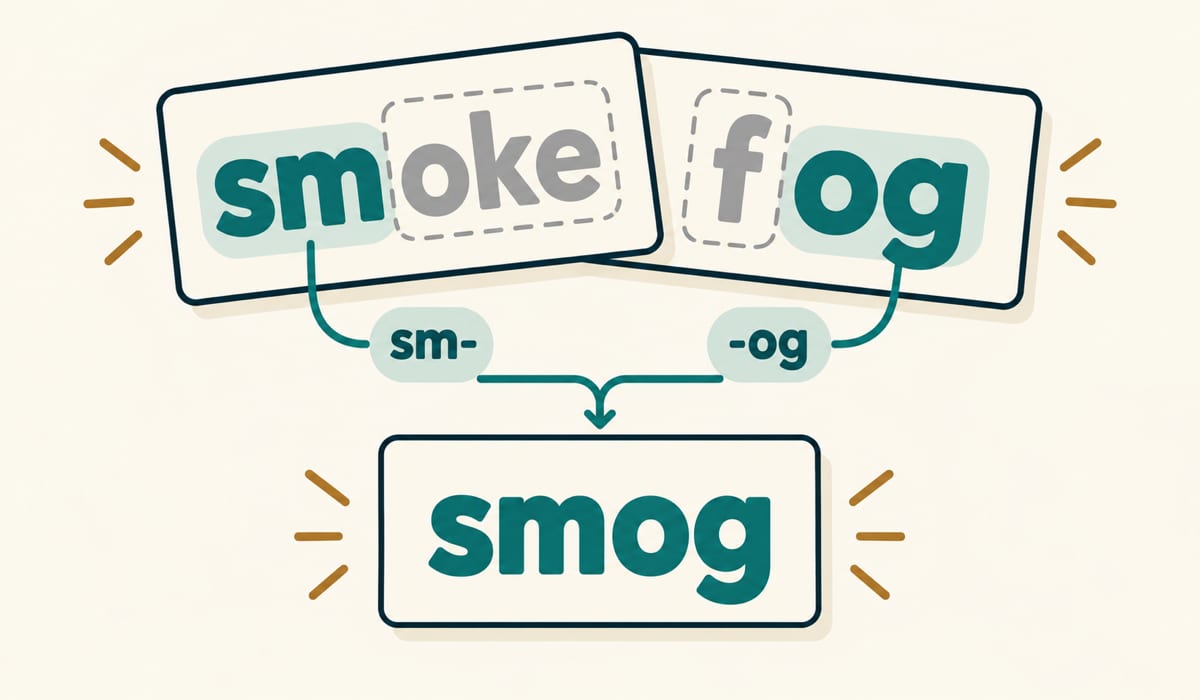
- the ‘smoke’ card donates its opening
- the ‘fog’ card donates its ending
- the blend ‘smog’ carries both meanings
Why Lewis Carroll called it a portmanteau
In Through the Looking-Glass (1871), Alice asks Humpty Dumpty to explain the strange words in “Jabberwocky.” He tells her that slithy means “lithe and slimy,” and that mimsy is “flimsy and miserable” — then adds: “You see it’s like a portmanteau — there are two meanings packed up into one word.”
A literal portmanteau was a travelling case that opened into two equal halves — English borrowed it from Middle French portemanteau, roughly “carries a cloak.” The Online Etymology Dictionary’s portmanteau entry records the luggage word from the 1580s and registers Carroll’s linguistic sense right behind it. His metaphor survives because it is exact: one case, two contents, packed deliberately.
Carroll was describing his own coinages, and some of them outlived the poem. Chortle — usually read as chuckle packed with snort — is now an ordinary dictionary word. That is the mark of a successful blend: readers keep the packed meaning without needing the packing explained.
The joke became the field’s word. Linguists also say blend, and some reserve portmanteau for blends whose pieces overlap; but in ordinary use Carroll’s suitcase is the name that stuck — a literary gag that turned into the technical term. That is worth pausing on: the word for this mechanism is itself a coinage with a named author and a dated document, which is more than most mechanism names can claim.
Blends that hid their parents: motel, brunch, Brexit
Motel is a blend with a documented birthday. The Etymonline motel entry dates it to 1925 — motor plus hotel — coined as the name for a planned chain of roadside motor hotels between San Diego and Seattle. The parents hid fast: nobody books a motel while picturing a motor and a hotel.
Brunch is older and less businesslike. Etymonline records it as 1896 British student slang merging breakfast and lunch, crediting a Hunter’s Weekly article by Guy Beringer that argued for the late-morning meal the year before. A joke about sleeping in produced one of the most durable blends in the language.
Brexit shows the machine still running at full speed: Etymonline dates it to 2012, Britain plus exit. Unlike smog or brunch it names a political event, which makes its two parents unusually visible — you can still hear both. That transparency is why blends are so easy to coin, and so easy to misread when the parentage is a guess rather than a record.
Blends versus compounds
A compound joins two whole words: bookcase, blackbird, motorway. Both parents arrive intact and stay readable inside the child. A blend keeps only pieces: nobody says smokefog, and motorhotel would be a compound, not a motel. The quick test is whether each parent survives whole; if a piece went missing, you are looking at a blend.
The splice often lands where the parents overlap in sound, which hides the seam. Motel cuts where motor’s ending shades into hotel’s middle; brunch is blunter carpentry — br- from breakfast, -unch from lunch — but the seam still disappears once the word beds in. When the join is invisible, the blend reads as if it were always a single word — which is exactly why the blended ones are so easy to miss.
Edges blur at the margins. Some coinages splice a whole word to a fragment (workaholic borrows only -aholic from alcoholic), and some old compounds have worn down until they look like blends. The label describes the formation event, not the shape of the word today — which is why the verdict belongs to a dated source, not to your eye. Nor is blending borrowing: a blend is built inside one language from two domestic words, while the chains that move words between languages are covered in loanwords, cognates and false friends.
When a blend guess is wrong
A tidy split into two plausible parents is a hypothesis, not a finding. The same warning the folk-etymology guide gives for neat origin stories applies here: resemblance is not evidence. A word can look exactly like x plus y and still be older than both supposed parents, borrowed whole from another language, or simply a coincidence of spelling.
Three checks catch most bad blend stories. First, does a dated dictionary entry actually call the word a blend — or does the split appear only in retellings? Second, do the supposed parents exist in the right era? A blend cannot predate the words it is claimed to pack. Third, is there a competing documented route — a borrowing chain, a clipping, a back-formation like the ones in the subtraction guide? If the record gives a different mechanism, the neat split is commentary, not origin.
Invent a blend, then check it
Blending is still productive because it is cheap: anyone can pack two words, and every year a few packings stick — hangry, staycation, webinar all followed the same path from joke to entry. Try it yourself: coin a blend, then check whether a dictionary already records it and whether it credits the parents you used. The check is the interesting part.
You can also run a suspected blend through the word lookup and see whether the generated reading splits it into the parents you expect — then verify that split against dated entries, because a reading is a research starting point, not a verdict. For a documented coinage of the opposite kind — a word its maker openly admitted inventing — compare the robot example, where the inventor and the date are part of the record.
Sources and further reading
- Project Gutenberg: Through the Looking-Glass — Carroll’s text, including Humpty Dumpty’s “two meanings packed up into one word” explanation.
- Online Etymology Dictionary: portmanteau — the cloak-carrier luggage word and Carroll’s linguistic sense.
- Online Etymology Dictionary: smog — the 1905 coinage made “after Lewis Carroll’s example.”
- Online Etymology Dictionary: motel, brunch and Brexit — dated blend records from 1925, 1896 and 2012.
The blend mechanism and the checking steps are original editorial guidance. Source summaries are intentionally brief. Sources consulted 1 October 2026.