
An acronym is a word built from the initial letters of a phrase and spoken as a word. That last part is the stricter usage’s distinction — Etymonline’s acronym entry notes the line is not universally agreed, and general dictionaries often use acronym for both kinds: say it as one word (scuba, radar) and it is an acronym; say it letter by letter (FBI, BBC) and it is an initialism. Both start as the same letter-shorthand. Only the acronym makes the jump to being a word in its own right.
Acronym versus initialism
The split is about pronunciation, not pedigree. An initialism stays a reading aid: you hear the letters, and the expansion does the real work — FBI still points at “Federal Bureau of Investigation.” An acronym detaches. Nobody sounding out scuba is silently expanding it; the string S-C-U-B-A has become a name for the gear.
Between the clean cases sit hybrids. JPEG is usually said “jay-peg” — the first letter spoken by name, the rest sounded out like a word — and plenty of strings go either way depending on the speaker. The labels describe how a form is spoken at a given moment, so a word can drift from initialism toward acronym as it settles into the language. What matters for the history is the same in both cases: whether the word came from the letters, and whether anyone can show it.
Scuba, laser, radar: initials that became words
Radar is the archetype: the Online Etymology Dictionary’s radar entry dates it to 1941, built from “radio detecting and ranging,” and notes the American coinage won out over the earlier British term radiolocation. The word happens to read the same forwards and backwards — a memorable accident, not a documented cause of its win.
Scuba followed in 1952 — Merriam-Webster’s entry expands it as “self-contained underwater breathing apparatus,” matching Etymonline’s account — and laser arrived in 1960: “light amplification by stimulated emission of radiation,” coined on the pattern of maser (1955), which did the same trick with microwaves.
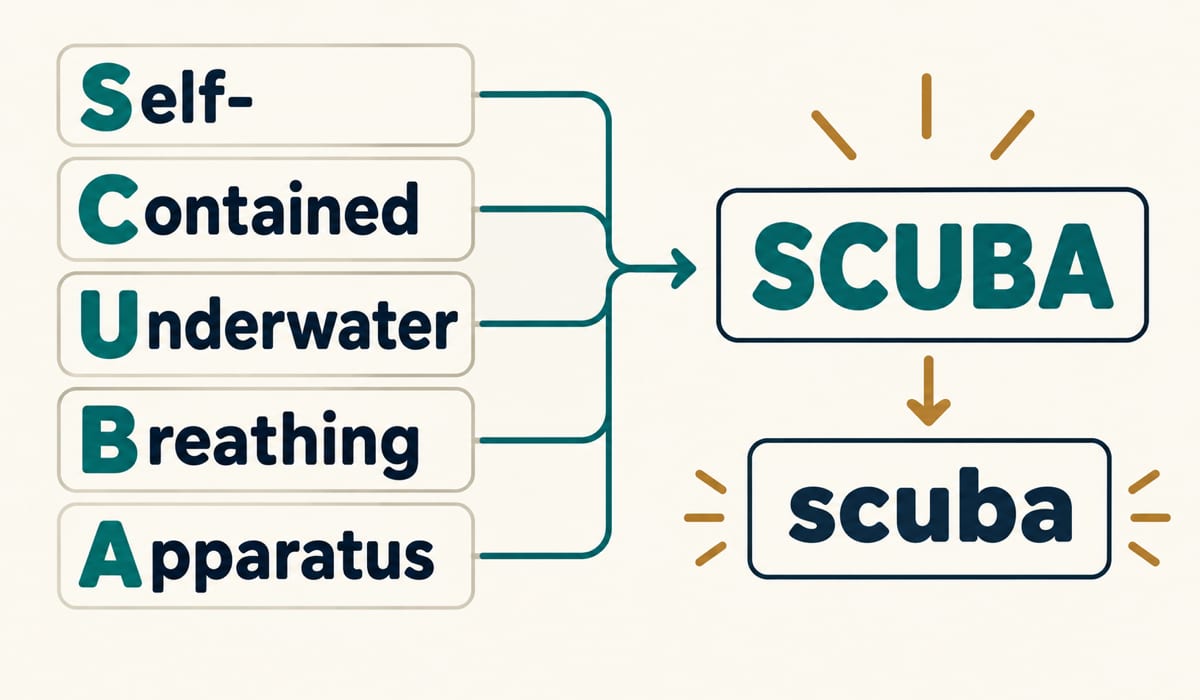
- a phrase needing a short name: ‘self-contained underwater breathing apparatus’
- initial letters kept in order: S-C-U-B-A
- a string that can be pronounced as a word
- capitals fall away as the word settles in
The proof of the jump is what happens next. A successful acronym loses its capitals, takes ordinary endings and compounds — scuba-diving, lasered — and its letters stop pointing anywhere. When the expansion has to be explained to native speakers, the word has fully arrived.
Why acronyms are mostly a 20th-century habit
Look at the dates: radar 1941, scuba 1952, maser 1955, laser 1960. The pattern clusters in the middle of the twentieth century because that is when the ingredients existed at scale: institutions generating long compound names (military programs, laboratories, agencies), near-universal literacy to keep letters stable, and print bureaucracies that needed short tags for long programs.
Earlier English abbreviated constantly — but initials mostly stayed initials, spoken or read as letter-names, not fused into new spoken words. Formation needs only a fixed, oft-repeated phrase plus a community impatient enough to compress it and literate enough to keep the letters stable — and twentieth-century armies, laboratories and agencies supplied those ingredients at industrial scale, which is why the documented examples cluster there. The institutional setting is common, not required: Etymonline’s snafu entry records a 1943 acronym built from a colloquial soldier’s expression — “situation normal, all fouled up” in the sanitized public version — not a program name. That is why a genuinely documented acronym-era word almost always turns out to be modern: the habit itself is modern. The glossary entry on acronym keeps the term’s scope narrow for exactly this reason.
The telltale sign of a fake acronym etymology
The telltale is a date problem wearing a cleverness costume. If a word is attested centuries before the age of acronym-building, a story that expands it into a tidy phrase has the sequence backwards: the phrase was fitted to the word afterward. Posh is the famous case — “port out, starboard home” is a neat expansion that Merriam-Webster’s account does not establish as the word’s origin.
The folk-etymology guide walks through the checking method for these stories; the short version is that a phrase fitting the letters proves nothing, because fitting letters is easy. What a real acronym claim needs is dated evidence of the phrase, dated first records of the short form, and a documented link between them.
A backward-built expansion has its own name: a backronym — a phrase assembled after the fact to fit letters that were never initials. The “gentlemen only” story attached to golf is the classic shape of one: the phrase exists only in the retelling, never in a dated record before the word. When the phrase comes first in the record, the claim is a formation story; when the word comes first, it is a backronym — and backronyms are commentary, not etymology.
Borderline cases: OK, and the documented exception
OK is the rare pre-20th-century exception — and its documentation is exactly what fake acronym stories lack. The Online Etymology Dictionary’s OK entry records it from 1839, from a Boston slang fad for jocular abbreviations: “oll korrect” — a deliberate misspelling of “all correct.” The 1840 presidential campaign probably carried it nationwide — both parties used it — when Martin Van Buren’s supporters ran O.K. clubs, supposedly in allusion to his nickname “Old Kinderhook.”
Two lessons hide in that one word. First, the exception proves the checking habit rather than the pattern: OK’s origin survived because newspapers and campaign records pinned it to a season. Second, its parent is not a sober technical phrase but a joke spelling — the 1830s version of wordplay. Even the genuine old “acronym” was built for fun, not by a committee.
Checking an acronym claim
Write the claimed expansion down exactly, with its claimed date, then check three things:
- Is the word’s first record later than the acronym era? A word attested before the twentieth century almost never comes from initials — unless, like OK, a documented fad explains it.
- Does the expansion appear in dated sources before the word? “Self-contained underwater breathing apparatus” is the real phrase behind scuba; fake expansions exist only as retellings.
- Does a dictionary name the expansion, or just the letters? An entry that expands radar and dates it to 1941 is reporting the record; an entry that calls an origin “uncertain” while a popular story says otherwise is telling you where the record ends.
Then try the word lookup on a genuine acronym-word and read it critically: does the generated reading expand the initials correctly, and does it attach a plausible date? A reading is a research starting point — the dated entries above are the check. For a word whose popular expansion fails the test, compare the algorithm example, where the tempting tidy story dissolves into a documented reshaping.
Sources and further reading
- Online Etymology Dictionary: radar — the 1941 “radio detecting and ranging” coinage that beat “radiolocation.”
- Merriam-Webster: scuba — the “self-contained underwater breathing apparatus” expansion.
- Online Etymology Dictionary: scuba and laser — the 1952 and 1960 coinage records, and the maser pattern.
- Online Etymology Dictionary: OK — the 1839 “oll korrect” fad and the 1840 campaign that spread it.
- Online Etymology Dictionary: snafu — acronym formation from a colloquial expression, not an institutional name.
- Online Etymology Dictionary: acronym — the term’s own record, and the note that the acronym–initialism split is not universally agreed.
- Merriam-Webster: posh — the unestablished “port out, starboard home” expansion.
The acronym/initialism distinction and the checking steps are original editorial guidance. Source summaries are intentionally brief. Sources consulted 1 October 2026.